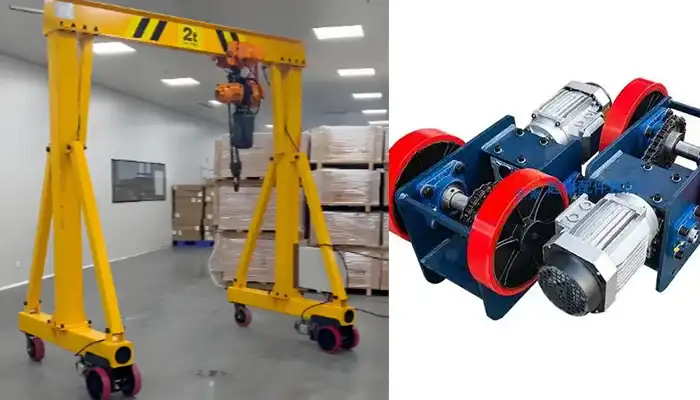
Portable Gantry Crane Problems: Wheels, Drift & Frame Issues
Content Quick Link
3 Things to Check Before Buying a Portable Gantry Crane
A portable gantry crane may look simple.A steel frame.Four wheels.An electric hoist.Many cranes even look almost the same.But after supplying cranes for years, we've noticed something.Most problems don't happen on the first day.The crane rolls smoothly when it's new.It lifts the rated load.Everything seems fine.Then six months later, buyers start asking questions.
"Why is the crane getting harder to move?" "Why doesn't it travel in a straight line anymore?" "Why does the frame feel less stable?"The good news is that most of these problems can be avoided.
You simply need to know what to ask before buying.
The Wheels Matter More Than You Think
This is probably the most common complaint we hear.The crane moved easily when it was new.A few months later, it became much harder to push or drive.
What changed? Usually, it's the wheels.
When low-quality wheels are used, the bearings inside begin to wear after months of regular use.As soon as the crane carries a heavy load, the swivel wheel may not turn smoothly.
The crane becomes difficult to steer.The operator has to use more force.Daily work becomes slower.
Before you buy, ask these questions:
- Are the wheels made of high-strength polyurethane?
- Do they use tapered roller bearings?
- What is the wheel's rated load capacity?
If the supplier cannot answer these questions clearly, keep looking.
Can the Crane Travel Straight?
Many electric portable gantry cranes use four powered wheels.That sounds great.But here's the problem.Workshop floors are rarely perfectly flat.There may be small slopes.
Expansion joints.Or worn concrete.Without a synchronization system, each wheel can move at a slightly different speed.One side moves faster.The other side moves slower.The crane slowly drifts sideways.Instead of moving straight, it moves at an angle.
This can cause:
- The crane to hit storage racks.
- Difficult load positioning.
- Damage to equipment.
- Safety risks for nearby workers.
Before you buy, ask this question:Does the crane have an electronic synchronization or differential control system?
If not, today's savings could become tomorrow's repair bill.
Don't Ignore the Frame Connection
Many buyers compare lifting capacity.Others compare price.Very few ask how the frame is connected.But this is one of the most important parts of the crane.Some low-cost cranes use ordinary bolts to connect the columns.At first, everything looks normal.But after repeated lifting and moving, the joints begin to loosen.The frame starts to flex.Over time, the crane may no longer stay square.
A portable gantry crane should stay rigid under load.
That's why a good design uses:
- Precision locating connections
- High-strength structural bolts
- A rigid column-to-beam connection
This is what keeps the crane stable.There is very little room for compromise.
Don't Judge a Crane by Its Price Alone
A lower price may look attractive.But replacing worn wheels, repairing the travel system, or fixing a twisted frame costs far more in the long run.A well-designed portable gantry crane usually saves money because it lasts longer, works more smoothly, and requires less maintenance.That's the value buyers often overlook.
A Quick Checklist Before You Place Your Order
Before choosing a portable gantry crane, ask your supplier:
- Are the wheels made from high-strength polyurethane?
- Do the wheels use tapered roller bearings?
- Does the travel system include electronic synchronization?
- How does the crane stay aligned on slightly uneven floors?
- How are the columns connected to the beam?
- Are high-strength structural bolts used?
- Can you provide technical specifications and inspection standards for these components?
A professional supplier should be able to answer these questions with confidence.If the answers are vague or unclear, that's a warning sign.Take a little extra time before buying.The right portable gantry crane should roll smoothly, travel straight, and stay rigid for years—not just during the first few weeks after installation.
FAQ: Portable Gantry Crane Buying Problems & What This Article Solved
Key buying issues of portable gantry cranes: wheel wear, travel deviation, and frame rigidity problems explained in a simple way before purchase.
Why does my portable gantry crane become hard to move after a few months?
This usually comes from wheel bearing wear.
When the crane is new, the swivel wheels roll smoothly. But after a few months of heavy use, low-quality bearings start to wear out. The wheel no longer rotates freely under load, so pushing or driving becomes difficult.
What to check before buying:
- High-strength polyurethane wheels
- Tapered roller bearings
- Clear wheel load rating for continuous use
Why does my gantry crane start moving in a crooked or diagonal line?
This is caused by poor synchronization between the four travel wheels.
On uneven workshop floors, each wheel may move at a slightly different speed. Without electronic synchronization, the crane drifts to one side instead of moving straight.
What to check before buying:
- Electronic synchronization / differential control system
- Stable multi-motor coordination design
- Floor tolerance compatibility guidance from supplier
Why does the gantry crane frame start to feel unstable over time?
This is usually a structural rigidity issue at the column connections.
If the crane uses ordinary bolts and weak joint design, repeated loading causes small deformation at the joints. Over time, the whole frame can lose alignment.
What to check before buying:
- Precision locating joints
- High-strength structural bolts
- Rigid column-to-beam connection design
Are these problems caused by misuse or poor installation?
In most cases, no.
These issues are usually related to:
- Design quality
- Component selection
- Manufacturing cost-cutting
Even with correct operation, low-quality design will still fail over time.
Why do cranes work fine at first but fail later?
Because many weaknesses are not visible on day one.
- New wheels always roll smoothly
- New frames always look straight
- New motors always feel synchronized
Problems only appear after:
- Months of wear
- Repeated loading cycles
- Real workshop conditions
How can buyers avoid these problems before purchasing?
You must check three key systems before ordering:
1) Wheel system
- Material + bearing type + load rating
2) Travel system
- Synchronization or control system for multi-wheel drive
3) Structural system
- Column connection design + bolt grade + rigidity
What is the main takeaway from this guide?
A portable gantry crane is not just about capacity or price.
The real long-term performance depends on:
- Wheel durability
- Travel synchronization
- Frame rigidity
If these three are not properly designed, problems will always appear later—even if the crane looks fine at the beginning.

Article by Bella ,who has been in the hoist and crane field since 2016. Bella provides overhead crane & gantry crane consultation services for clients who need a customized overhead travelling crane solution.Contact her to get free consultation.
Yuantai Cranes
Yuantai Cranes - Global Material Handling Crane Solution Provider & Manufacturer with CE, ISO, SGS, CNEX and other Third Party Certifications.
- Main Specifications - Capacity: 0.5–550 tons | Span: up to 40m | Speed: 0.8–12 m/min | Duty: A3–A7 | Power: 380–690V, 50/60Hz | Control: pendant/remote/cabin
- Full engineering: FEA/PLC/VFD + in-house build + global delivery + on-site support, for workshops, factories, EPC contractors, industrial projects, etc.
- Support: design, manufacturing, testing, service – end-to-end, customized lifting solutions worldwide.
Get Your Custom Quote – Quick & Easy
Fill in what you know. Skip what you don't – we'll help.
- Crane type:_____ . (e.g., overhead crane, gantry crane, jib crane)
- Max weight to lift:_____ tons. (e.g., 2t, 5t, 10t, 20t, 50t)
- Lifting height:_____ m. (How high does the hook need to reach?
- Workshop width (span):_____ m . (Distance between the two crane rails)
- Travel distance:_____ m . (How long does the crane need to move along the runway?)
- Control type:_____. (Pendant / remote / cabin Control)
- Power supply:_____. (Local voltage & frequency – e.g., 380V, 50Hz, 3-phase)
- What will it be used for?_____ (e.g., steel fabrication, concrete products, mold handling, general manufacturing, etc.)
- Any special requirements?_____ (e.g., extreme temperature, dusty or explosive environment, special paint color, etc.)
Just leave a message via the contact form and our hoist and crane engineer will contact you with in 24working hours.
Inquire Yuantai Cranes