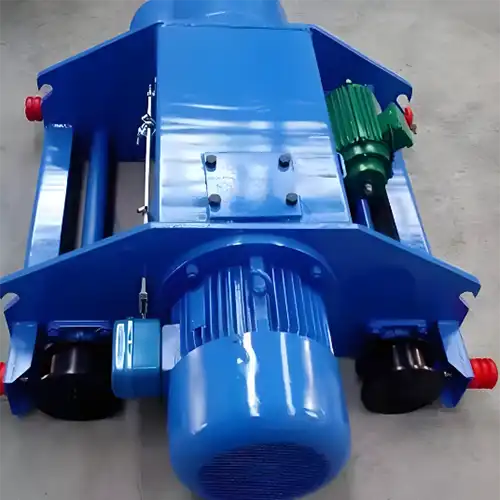
Integrated Trolley Electric Hoist 3 Ton to 32 Ton for Sale
High-quality Integrated Trolley Electric Hoists (3 Ton to 32 Ton) for sale, offering efficient, space-saving, and durable lifting solutions.
| Crane Type | Integrated Electric Hoist Trolley / Compact Electric Hoist Trolley, ISO M3–M6 / FEM 1Am–3M |
| Crane Capacity | 0.5–35 Ton (Common: 1 Ton, 2 Ton, 3 Ton, 5 Ton, 10 Ton) |
| Span Length | Common Types & Usages:Available as integrated wire rope hoist trolleys, low headroom trolley hoists, and compact motorized trolley systems for industrial lifting applications. |
| Lifting Height | 3–30 m (Common: 6 m, 9 m, 12 m) |
| Coverage Area Type | Installation Type:Compact integrated trolley design for double girder overhead cranes and gantry cranes,etc. |
| Application | Designed for machinery factories, assembly lines, warehouses, workshops, and production facilities. Used for material transfer, equipment lifting, positioning, assembly, and maintenance operations. |
| Certifications | CE / ISO / SGS / Other third-party inspection |
| Customization | Customized for crane systems and production lines. Options include VFD travel control, dual-speed lifting, low headroom design, remote control, overload protection, PLC integration, and custom lifting solu |
Crane Manufacturer: Yuantai Cranes – 30+ Years Professional Crane Manufacturer from China
Category: Hoist
Tags: electrichoist
Your Trusted Electric Wire Rope Hoist Manufacturer & Supplier
Integrated Trolley Electric Hoist 3 Ton to 32 Ton for Sale
High-quality Integrated Trolley Electric Hoists (3 Ton to 32 Ton) for sale, offering efficient, space-saving, and durable lifting solutions.
Overview of Integrated Trolley Electric Hoists
Integrated trolley electric hoists are lifting systems that combine a hoist and a trolley into a single unit. The hoist is responsible for lifting heavy loads, while the trolley moves the load along a beam or rail. This design helps save space and provides a compact solution for lifting in tight areas.
These hoists are especially useful in industries that require efficient, heavy-duty lifting. Whether it's for manufacturing, construction, or warehouses, integrated trolley hoists offer an effective way to move and lift heavy materials with ease. The integration of the hoist and trolley means there are fewer moving parts to maintain, making them reliable and easier to manage.
Key Benefits:
- Space-saving design for compact working areas.
- Reduced maintenance due to fewer components.
- Increased safety with advanced control systems.
- Higher lifting efficiency and precision.

integrated electric hoist trolley for sale
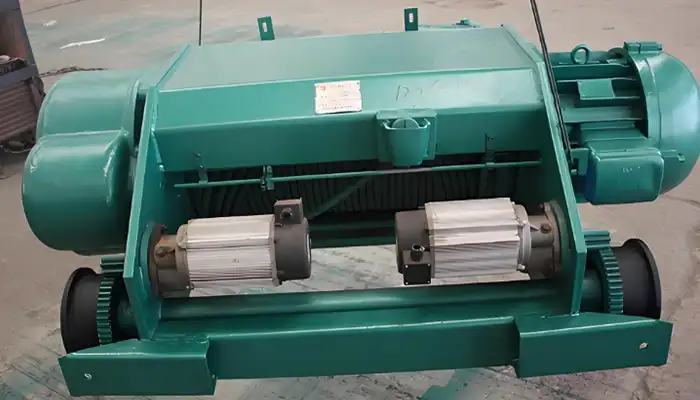
integrated hoist, customized electric wire rope hoist trolley for double girder crane
What is an Integrated Trolley Electric Hoist?
An integrated trolley electric hoist combines lifting and horizontal movement into a single compact system, improving efficiency, precision, and space utilization in material handling operations.
Definition and Components
An integrated trolley electric hoist combines two essential components—the hoist and the trolley—into one unified system. This design enables both vertical and horizontal movement of loads, offering a compact and efficient lifting solution.
Trolley Mechanism: The trolley moves the hoist along a rail or beam, allowing precise positioning of the load across the work area. It can be manual or electrically powered, with powered trolleys providing smoother and more efficient travel.
Electric Hoist: The hoist is the primary lifting mechanism powered by an electric motor, using a chain or wire rope to raise and lower loads.
Main Components:
Hoist: Responsible for vertical lifting.
Trolley: Enables horizontal movement along beams or rails.
Motor: Drives lifting and/or travel motions.
Control System: Allows operators to control lifting and travel via pendant or remote control.
How It Works
The integrated trolley electric hoist operates as a coordinated system where lifting and travel functions work together seamlessly.
Basic Operation: When activated, the motor lifts the load vertically while the trolley simultaneously moves along the beam, positioning the load accurately within the workspace.
Dual-Motion System: The hoist provides vertical motion, while the trolley ensures horizontal travel. This combination allows efficient handling of loads across multiple directions without requiring separate equipment.
Advantages of Integration
Integrating the hoist and trolley into a single unit offers several operational and structural advantages:
Space-Saving: Eliminates the need for separate systems, reducing installation space and simplifying structure design.
Efficiency: Combined lifting and travel functions minimize handling time and improve workflow productivity.
Smooth Operation: Integrated control ensures stable, precise, and synchronized movements, reducing load swing and mechanical stress.
This unified system enhances safety, performance, and operational efficiency, making it ideal for modern material handling applications.
Parameters of Integrated Hoist Trolley Double Girder
Specification | Trolley height H1(mm) | Trolley flange width (mm) | Safe distance | H3(mm)Hook effective length H3(mm) | Overall height H(mm) | Trolley axle length L(mm) | Wheelbase L1(mm) | Housing space L2(mm) | Wheel Dia. D(mm) | Wheel height M(mm) | Traveling motor |
2T | 326 | 800/900 | 200 | 420 | 946 | 860 | 770 | 580 | 147 | 50 | 0.4 |
3T | 350 | 850/950 | 200 | 455 | 1005 | 860 | 770 | 580 | 147 | 50 | 0.4 |
5T | 420 | 940/1050 | 200 | 570 | 1190 | 945 | 850 | 658 | 178 | 53 | 0.75 |
10T | 482 | 1180 | 200 | 550 | 1232 | 1305 | 1200 | 1023 | 200 | 60 | 0.75*2 |
10/5T | 482 | 1580/1690 | 200 | 550 | 1232 | 1305 | 1200 | 1023 | 200 | 60 | 0.75*2 |
16T | 500 | 1215 | 200 | 580/650 | 1280/1350 | 1305 | 1200 | 1020 | 216 | 65 | 0.75*2 |
20T | 600 | 1380 | 200 | 680/800 | 1450/1600 | 1515 | 1400 | 1230 | 243 | 70 | 1.1*2 |
25T | 600 | 1380 | 300 | 900 | 1800 | 1515 | 1400 | 1230 | 243 | 70 | 1.5*2 |
32T | 650 | 1600 | 300 | 980 | 1930 | 1625 | 1500 | 1340 | 270 | 80 | 1.5*2 |
25/5T | 600 | 1810 | 300 | 900 | 1800 | 1525 | 1400 | 1230 | 270 | 80 | 1.5*2 |
20/5T | 600 | 1810 | 300 | 680/800 | 1480/1600 | 1515 | 1400 | 1230 | 243 | 70 | 1.1*2 |
32/5T | 650 | 2000 | 300 | 980 | 1930 | 1625 | 1500 | 1340 | 270 | 70 |
Main Parts and Components of Integrated Wire Rope Hoist Trolley (Double Girder)
Core Components Overview
The integrated wire rope hoist double girder system consists of key components including the reducer, traveling mechanism, wire rope drum device, hook device, coupling, slow-speed driving device (MD1 model), current inducer, limit switch, and motor. This integrated design simplifies maintenance, reduces downtime, and improves overall durability.
Motor and Drive System
Conical Brake Motor: Provides reliable braking and high starting torque, suitable for frequent start-stop operations.
Lifting Speeds: Available in single-speed (CD1) and dual-speed (MD1) configurations for flexible operation.
Motor Performance: Delivers torque 2.4–3 times the rated value, ensuring stable performance under heavy loads.
Reducer and Transmission
Helical Gear Reducer: Standard modular design simplifies assembly and maintenance.
Triple Bevel Gear Reducer: Made from 40Cr or 20CrMnTi steel with heat treatment for durability.
Gearbox Construction: Cast iron housing with rolling bearings ensures dustproof sealing and long service life.
Coupling: Elastic claw-type coupling absorbs shock and ensures smooth torque transmission.
Traveling Mechanism
The traveling mechanism is designed as an electric trolley system with a sealed gearbox and rolling bearings for smooth motion.
Material: Forged 40Cr steel gears with heat treatment.
Rail Standard: Complies with GB/T706-198 specifications.
Advanced Configurations: For lifting heights above 18m, balance beam trolleys are used; higher capacity models (8t–20t) may require dual trolley systems.
Drum and Hook Device
Drum Device: Constructed from cast steel or seamless steel tubes, connected via spline shaft and supported by rolling bearings for stability.
Hook Device: Made from forged 20# steel with thrust ball bearings for smooth rotation.
Design Options: Single pulley for smaller capacities; double pulley systems for 8t–20t applications.
Auxiliary Systems
Slow-Speed Driving Device (MD1): Includes auxiliary motor and reduction gear (10:1 ratio) for precision lifting.
Current Inductor: Power is supplied through cable leads directly into the control system.
Limit Switch: Automatically cuts power when hook reaches upper or lower limits, preventing over-travel and mechanical damage.
Key Features of Integrated Trolley Electric Hoists
Integrated trolley electric hoists are engineered for compactness, durability, safety, precision, and energy efficiency, making them ideal for modern material handling systems.
Compact and Space-Saving Design
One of the primary benefits of integrated trolley electric hoists is their compact and efficient design, making them ideal for space-constrained environments.
Reduced Overhead Space Requirements: By combining the hoist and trolley into a single unit, the system minimizes structural complexity and reduces the footprint compared to traditional setups.
Maximized Workspace Below: The streamlined configuration frees up valuable floor space, improving workflow efficiency in warehouses, factories, and production lines.
This compact design simplifies installation while optimizing both vertical and horizontal space utilization.
Durable and Robust Construction
Integrated trolley electric hoists are designed for heavy-duty performance in demanding industrial environments.
High-Strength Materials: Manufactured using steel and alloy components that resist wear, corrosion, and mechanical stress.
Long-Term Reliability: Capable of handling continuous and heavy loads while maintaining structural integrity over extended service life.
This robust construction reduces maintenance frequency and ensures dependable operation in industries such as construction, logistics, and manufacturing.
Advanced Safety Features
Safety is integral to the design of integrated trolley electric hoists, with multiple built-in protection systems.
Overload Protection: Prevents operation when the load exceeds rated capacity, protecting both equipment and operators.
Limit Switches: Automatically stop lifting or lowering beyond safe limits to avoid mechanical damage.
Emergency Stop: Instantly halts all movement in critical situations, ensuring rapid response to hazards.
These features significantly reduce operational risks and improve workplace safety.
Smooth and Precise Operation
Integrated systems deliver accurate and stable load handling for a wide range of applications.
Advanced Control Systems: Allow precise adjustment of lifting and traveling speeds for different load conditions.
Reduced Load Swing: Smooth motion minimizes vibration and enhances positioning accuracy.
Protection of Goods: Controlled handling reduces the risk of damage to delicate or high-value materials.
This precision is essential for operations requiring both efficiency and careful handling.
Energy-Efficient Performance
Energy efficiency is a key advantage of modern integrated trolley electric hoists.
Low Power Consumption: Equipped with efficient motors that deliver high output with reduced energy usage.
Operational Cost Savings: Lower electricity consumption translates into reduced long-term operating expenses.
Sustainable Operation: Supports environmentally friendly practices by minimizing energy waste.
This efficiency makes integrated hoists a cost-effective and sustainable solution for industrial lifting applications.
Applications of Integrated Trolley Electric Hoists
Integrated trolley electric hoists are widely used across industrial and specialized sectors, offering efficient, space-saving, and reliable lifting solutions for both indoor and outdoor applications.
Industrial Use
Integrated trolley electric hoists are essential in industries where frequent and heavy lifting is required, particularly in environments with limited space.
Manufacturing: Used for lifting raw materials, components, and heavy machinery parts to support efficient production processes.
Construction: Ideal for handling building materials, steel structures, and equipment, improving construction speed and safety.
Warehousing: Facilitates movement of bulk goods, pallets, and large equipment, enhancing storage and logistics efficiency.
Their compact and integrated design makes them highly effective in maximizing productivity while maintaining safety in confined industrial environments.
Specialized Applications
These hoists are also adapted for specialized industries requiring high precision and heavy-duty performance.
Automotive Industry: Used for lifting engines, chassis, and transmission systems during assembly and maintenance.
Heavy Machinery Sector: Enables efficient handling of large mechanical components and industrial equipment.
Shipbuilding: Supports movement of large structural sections, engines, and ship components in shipyards.
Their flexibility and load capacity make them indispensable in complex and demanding operational environments.
Outdoor vs Indoor Use
Integrated trolley electric hoists can be designed for both indoor and outdoor environments, depending on operational requirements.
Indoor Use: Typically installed in controlled environments such as factories and warehouses, with protection against dust and optimized for consistent operating conditions.
Outdoor Use: Engineered with weather-resistant features such as anti-corrosion coatings, sealed components, and reinforced motors to withstand moisture, temperature variations, and harsh environmental conditions.
Outdoor applications are common in construction sites, ports, and open industrial facilities where durability and environmental resistance are critical.

Integrated electric hoist 3 ton for double girder crane

Low profile integrated hoist trolley for low headroom workshops

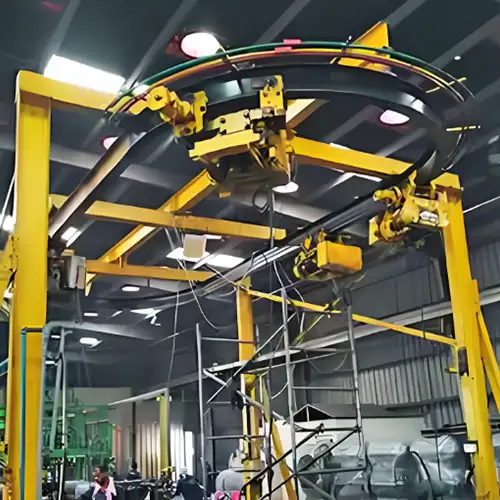
Double track integrated wire rope hoist trolley crane

Low profile and low headroom hoist crane with integrated hoist trolley
Load Capacities and Performance
Integrated trolley electric hoists offer a wide capacity range and customizable performance features, ensuring efficient and safe lifting across various industrial applications.
Capacity Range: 3 Ton to 32 Ton
Integrated trolley electric hoists are available in capacities ranging from 3 tons to 32 tons, allowing businesses to select the right model for their specific lifting needs.
3 Ton to 10 Ton: Suitable for light to medium-duty applications such as manufacturing, assembly lines, and warehouse handling of equipment and components.
10 Ton to 20 Ton: Commonly used in construction, automotive plants, and machinery handling where higher lifting strength is required.
20 Ton to 32 Ton: Designed for heavy-duty industries such as shipbuilding, large-scale construction, and heavy equipment manufacturing.
This wide capacity range ensures flexibility, enabling efficient and safe handling of various load types and weights.
Lifting Heights and Speeds
Integrated trolley electric hoists can be customized to meet specific lifting height and speed requirements.
Custom Lifting Height: Adjustable to match facility requirements, especially useful in high-bay warehouses, construction sites, and multi-level operations.
Variable Speed Options: Allows operators to choose between slow speeds for precise positioning and higher speeds for efficient material transfer.
These customizable parameters enhance operational efficiency and adaptability across different working environments.
Factors Affecting Performance
Several key factors influence the overall performance and reliability of integrated trolley electric hoists:
Load Weight: Heavier loads require higher capacity hoists and may impact lifting speed and efficiency.
Environmental Conditions: Exposure to moisture, temperature extremes, or corrosive elements can affect durability and performance, requiring specialized protective features.
Operational Demands: High-frequency usage and continuous operation require more robust designs to maintain performance and reduce wear.
Evaluating these factors ensures optimal hoist selection, maximizing safety, efficiency, and long-term operational reliability.
Benefits of Choosing an Integrated Trolley Electric Hoist
Integrated trolley electric hoists provide measurable gains in productivity, space utilization, reliability, and safety—making them a strategic investment for modern industrial operations.
Increased Productivity
Integrated trolley electric hoists significantly enhance operational throughput by optimizing lifting efficiency and minimizing interruptions.
Faster Lifting Cycles: Smooth and stable lifting mechanisms reduce cycle time, enabling quicker material handling and improved workflow continuity.
Reduced Downtime: Simplified mechanical design and high reliability lower the risk of breakdowns, ensuring consistent operation in high-demand environments.
These advantages directly translate into higher productivity and improved operational efficiency.
Space Efficiency
Space optimization is a critical benefit, particularly in dense industrial layouts.
Compact Integrated Design: Combining hoist and trolley into a single unit reduces structural complexity and equipment footprint.
Maximized Operational Area: Frees up valuable floor and overhead space, allowing for better equipment arrangement and workflow organization.
This efficiency is especially valuable in factories, warehouses, and assembly lines where space constraints impact productivity.
Long-Term Reliability
Designed for durability, integrated trolley electric hoists deliver consistent performance over extended service life.
Robust Construction: Built from high-grade materials to withstand heavy loads and continuous operation.
Low Maintenance Requirements: Reduced component complexity leads to fewer maintenance interventions and lower lifecycle costs.
This long-term reliability makes them a cost-effective solution for demanding industrial applications.
Improved Safety
Safety performance is enhanced through integrated protective systems and precise control.
Built-In Safety Mechanisms: Includes overload protection, limit switches, and emergency stop functions to prevent unsafe operation.
Controlled and Stable Movement: Smooth acceleration and deceleration reduce load swing and minimize accident risks.
These features ensure safer working conditions while protecting both personnel and equipment during lifting operations.
Why Buy Integrated Trolley Electric Hoists for Sale?
Integrated trolley electric hoists offer a compelling combination of cost efficiency, customization flexibility, global availability, and reliable after-sales support—making them a practical and strategic investment for industrial lifting needs.
Cost-Effectiveness
Integrated trolley electric hoists provide an economical solution by combining lifting and traveling functions into one system, reducing both upfront and long-term costs.
Affordable High Performance: Direct sourcing from reliable manufacturers ensures competitive pricing without compromising quality.
Long-Term Value: Durable construction and efficient operation reduce maintenance, repair costs, and downtime over the equipment's lifecycle.
This balance of cost and performance makes them a highly cost-efficient investment.
Customization Options
Integrated trolley electric hoists can be tailored to meet diverse operational requirements across industries.
Industry-Specific Design: Adapted for applications ranging from heavy construction lifting to precision manufacturing tasks.
Flexible Configuration: Options include varying load capacities, lifting speeds, control systems, and enhanced safety features.
Customization ensures optimal performance and compatibility with specific working conditions.
Global Availability and Shipping
These hoists are widely available through international suppliers, making procurement accessible regardless of location.
Worldwide Supply: Available in multiple regions to meet global industrial demand.
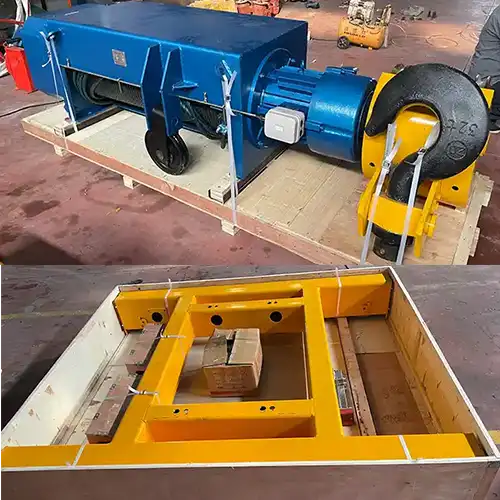
Reliable Logistics: Established shipping systems ensure safe delivery, proper packaging, and timely arrival.
This global accessibility simplifies procurement for businesses operating across different markets.
Warranty and Support
Purchasing an integrated trolley electric hoist includes comprehensive after-sales service and technical support.
Warranty Coverage: Protects against manufacturing defects and ensures confidence in product quality.
Technical Assistance: Access to expert support for installation, operation, maintenance, and troubleshooting.
Strong after-sales support ensures long-term operational reliability and minimizes disruptions.
Choosing the Right Hoist for Your Needs
Selecting the right hoist involves evaluating load capacity, customization requirements, and operating environment to ensure safe, efficient, and long-lasting performance.
How to Determine the Right Capacity
Choosing the correct hoist capacity is essential for safe and efficient lifting operations.
Load Type: Evaluate the weight, shape, and characteristics of the materials being lifted. Bulky or uneven loads may require higher capacity.
Safety Margin: Always select a hoist with a capacity above the maximum expected load to accommodate fluctuations.
Environmental Conditions: Harsh environments or extreme temperatures may require more robust hoists with higher capacity ratings.
For instance, lifting a 2-ton load with a 3-ton hoist improves safety and extends equipment lifespan.
Customization Needs
Hoists can be customized to meet specific operational and environmental requirements.
Lifting Height: Select appropriate lifting range or request extended height configurations.
Speed Control: Adjustable speeds enable precise handling for sensitive or complex tasks.
Power Source: Choose from electric, manual, or battery-powered systems based on facility conditions.
Safety Features: Options such as explosion-proof or weatherproof designs enhance operational safety.
Proper customization improves efficiency and minimizes operational risks.
Considerations for Indoor vs Outdoor Use
The operating environment plays a critical role in selecting the appropriate hoist design.
Indoor Use: Requires compact design, quiet operation, and flexible installation for confined spaces.
Outdoor Use: Demands weather-resistant materials, corrosion protection, and durable electrical components.
Operating Conditions: Factors such as humidity, dust, wind, and temperature extremes must be considered when selecting protective features.
Matching the hoist to its environment ensures reliable performance and longer service life.
Send Us an Inquiry to Get Your Integrated Hoist
Integrated trolley electric hoists provide a versatile, space-saving, and efficient solution for lifting heavy loads. Their key benefits include:
- Compact Design: The integration of the hoist and trolley reduces the overall system footprint, making it ideal for environments with limited overhead space.
- Durability: Built to withstand heavy-duty operations, these hoists feature robust construction, ensuring long-lasting performance even in tough conditions.
- Advanced Safety Features: With built-in safety mechanisms such as overload protection, limit switches, and emergency stops, these hoists prioritize operator safety and equipment protection.
- Smooth and Precise Operation: The coordinated movement of the hoist and trolley allows for controlled and accurate load handling, increasing productivity.
- Energy Efficiency: Designed to reduce energy consumption, integrated trolley hoists contribute to cost savings and lower environmental impact.
Final Recommendation for Buyers
When selecting an integrated trolley electric hoist, it's important to consider the specific requirements of your operation, such as load capacity, lifting height, and environmental conditions. These hoists are well-suited for industries like manufacturing, construction, and logistics, offering a seamless solution for both vertical and horizontal lifting tasks.
For those looking for a compact, durable, and efficient hoisting solution, an integrated trolley electric hoist is an excellent investment that will improve operational efficiency, enhance safety, and reduce maintenance costs in the long term.
If you're ready to explore how an integrated trolley electric hoist can benefit your operation, or if you need more information or a custom quote, don't hesitate to reach out to our team.Our expert team is here to provide tailored solutions and ensure you make the best choice for your hoisting needs. Contact us to get your customized design and specific integrated electric hoist trolley price.

Yuantai Cranes
Overhead Crane Manufacturer with CE, ISO, SGS, CNEX Certificates.
- Main Specifications - Capacity: 0.5–550 tons | Span: up to 40m | Speed: 0.8–12 m/min | Duty: A3–A7 | Power: 380–690V, 50/60Hz | Control: pendant/remote/cabin
- Full engineering: FEA/PLC/VFD + in-house build + global delivery + on-site support, for workshops, factories, EPC contractors, industrial projects, etc.
- Support: design, manufacturing, testing, service – end-to-end, customized lifting solutions worldwide.
How to Get an Accurate Crane Price for Your Application?
Tips: Copy the spec list, fill in your details, and paste it into the form on the right/ down-below for a quick price.
- Crane type:_____ . (e.g., overhead crane, gantry crane, jib crane)
- Max weight to lift:_____ tons. (e.g., 2t, 5t, 10t, 20t, 50t)
- Lifting height:_____ m. (How high does the hook need to reach?
- Workshop width (span):_____ m . (Distance between the two crane rails)
- Travel distance:_____ m . (How long does the crane need to move along the runway?)
- Control type:_____. (Pendant / remote / cabin Control)
- Power supply:_____. (Local voltage & frequency – e.g., 380V, 50Hz, 3-phase)
- What will it be used for?_____ (e.g., steel fabrication, concrete products, mold handling, general manufacturing, etc.)
- Any special requirements?_____ (e.g., extreme temperature, dusty or explosive environment, special paint color, etc.)
Just leave a message via the contact form and our hoist and crane engineer will contact you with in 24working hours.
Get Your Custom Quote–Quick & Easy
Fill in what you know. Skip what you don't – we'll help.Any question will be reply with 24 working hours