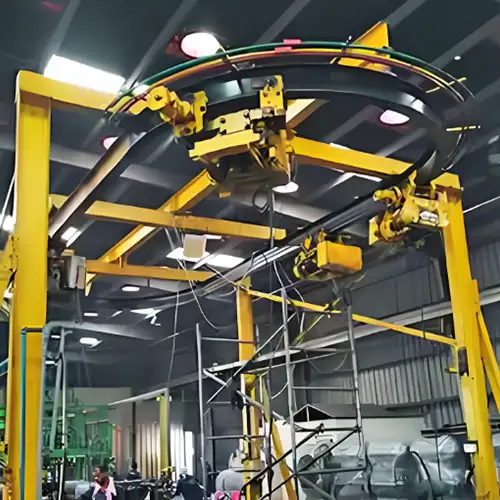
Monorail Electric Hoists Designed for Curved Rails or Tracks
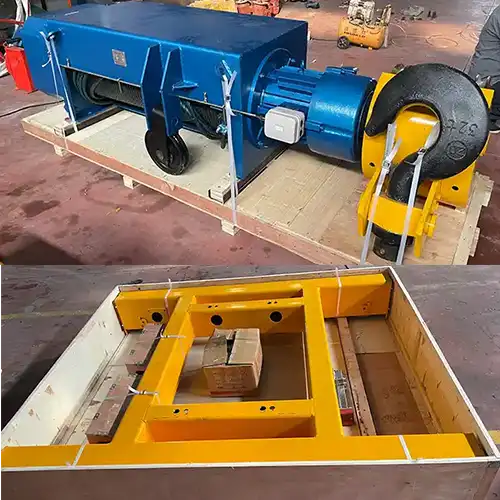
Curved track hoist for sale. Monorail electric hoists for curved rails enhance maneuverability, optimize space& improve material handling efficiency.
| Crane Type | Monorail Electric Hoist / Curved Rail Electric Hoist, ISO M3–M6 / FEM 1Am–3M |
| Crane Capacity | 0.5–35 Ton (Common: 1 Ton, 2 Ton, 3 Ton, 5 Ton, 10 Ton) |
| Lifting Height | 3–20 m (Common: 3 m, 6 m, 9 m, 12 m) |
| Coverage Area Type | Installation Type:Motorized trolley hoist designed for straight and curved monorail tracks, KBK systems, and customized overhead transport systems. |
| Application | Designed for automotive plants, assembly lines, machinery factories, warehouses, and production workshops. Used for continuous material transfer, component handling, assembly, positioning, and production line feeding. |
| Certifications | CE / ISO / SGS / Other third-party inspection |
| Customization | Customized for production lines and automated material handling systems. Options include curved track layout, electric travel control, VFD control, PLC integration, remote control, anti-sway function, and custom lifting solutions. |
Crane Manufacturer: Yuantai Cranes – 30+ Years Professional Crane Manufacturer from China
Category: Hoist
Tags: electrichoist,monorails
Your Trusted Electric Hoist Manufacturer & Supplier
Monorail Electric Hoists Designed for Curved Rails or Tracks
Curved track hoist for sale. Monorail electric hoists for curved rails enhance maneuverability, optimize space& improve material handling efficiency.
Monorail Electric Hoists Designed for Curved Rails or Tracks
Electric hoists are essential lifting devices used in various industries for handling heavy materials and equipment. Designed to operate smoothly on monorail systems, they play a crucial role in streamlining workflows and increasing productivity in industrial environments. However, when it comes to curved rail systems, electric hoists require specific configurations to maintain performance and ensure safe operation.
Curved rail systems are common in many modern industrial settings, particularly where space is limited or when the production process demands non-linear movement. These systems allow hoists to follow customized paths, enabling more versatile and efficient material handling. In such cases, choosing the right electric hoist—capable of handling curves without compromising on performance—is vital to achieving smooth and precise operations.
Selecting an electric hoist for a curved rail system involves more than just lifting capacity. The ability of the hoist to navigate bends and maintain balance during turns is critical. Improper selection could result in unstable movements, increased wear on the equipment, and even safety risks. For industries like manufacturing, warehousing, and assembly lines, where curved tracks are often used to optimize space or maneuver around obstacles, ensuring the hoist's compatibility with the curve radius and rail design is essential for consistent and safe operations.
Benefits of Using Electric Hoists on Curved Rails
Optimizing Material Handling Efficiency in Confined Spaces Curved rail systems allow electric hoists to operate in confined or irregularly shaped spaces, offering an effective solution where traditional straight rail systems may not fit. By following customized paths, these hoists can bypass obstacles, transport materials efficiently, and eliminate the need for additional equipment, reducing operational complexity.
Flexibility in Non-linear Workflows In environments where the production process isn't confined to straight-line movement, such as in certain assembly lines or workshops with multiple workstations, curved rails enable the hoist to seamlessly follow the workflow. This flexibility enhances overall productivity, as materials can be transported directly along the most efficient route without unnecessary detours, saving time and labor.

European Style Curved Track Monorail Electric Hoists

CD/MD Curved Track Monorail Electric Hoists
European Style Curved Track Monorail Electric Hoists
European-style electric hoists are engineered for superior performance on curved monorail systems, offering compact design, advanced controls, and high adaptability for complex track layouts.
Advanced Design for Curved Rail Compatibility
European-style electric hoists feature an advanced design optimized for smooth operation on curved rail systems.
Engineered for Curves: Specifically designed to handle non-linear tracks, unlike traditional CD hoists.
Adaptability: Performs efficiently on tight curves and complex rail layouts.
Enhanced Stability: Improved structure and control reduce operational stress on curved paths.
This makes them highly suitable for modern material handling systems with intricate rail configurations.
Compact and Low-Headroom Design
The compact and low-headroom structure allows efficient operation in restricted vertical spaces.
Space-Saving Design: Ideal for facilities with limited overhead clearance such as warehouses and workshops.
Improved Maneuverability: Enables smooth travel through curved sections without obstruction.
Reduced Collision Risk: Compact build minimizes interference with surrounding structures.
This design ensures maximum usability in confined or complex environments.
Enhanced Control Features
Advanced control technologies improve operational precision and safety on curved tracks.
Variable Frequency Drives (VFDs): Provide smooth acceleration and deceleration for stable curve navigation.
Speed Adjustment: Allows optimization of speed based on curve radius to reduce mechanical strain.
Precision Handling: Ensures controlled, stable movements and minimizes sudden jerks.
These features enhance both safety and efficiency during operation.
Special Customization for Curved Rail Applications
European-style hoists can be tailored to meet specific curved rail system requirements.
Customized Trolley and Suspension: Designed to match unique track curvature.
Integrated Sensors: Enhance control and monitoring during curved movement.
Optimized Performance: Ensures smooth, safe, and efficient handling even in complex layouts.
Customization makes these hoists a preferred solution for demanding curved rail applications.
CD1/MD1 Curved Track Monorail Electric Hoists (Traditional)
CD1/MD1 electric hoists are widely used traditional lifting solutions known for their simplicity and durability, but they have limitations when operating on curved monorail systems.
Basic Features and Design
CD electric hoists are commonly used in industrial environments due to their simple and robust construction.
Single-Speed Motor: Provides reliable and consistent lifting performance for general applications.
Wide Capacity Range: Typically handles loads from 0.5 ton to 32 ton.
Cost-Effective Design: Straightforward structure ensures affordability and ease of maintenance.
Their durability and practicality make them a standard choice for many lifting operations.
Common Applications and Limitations on Curved Rails
While effective on straight tracks, CD hoists are not specifically designed for curved rail systems.
Typical Applications: Suitable for workshops, warehouses, and general material handling on straight monorails.
Limited Curve Adaptability: Lack of advanced control systems can result in unstable movement on curves.
Higher Headroom Requirement: May restrict use in low-clearance environments.
These limitations can impact efficiency and safety in curved track applications.
Performance on Curved Tracks: Strengths and Challenges
CD hoists provide dependable lifting but face performance challenges on curved rails.
Strengths: Reliable for basic lifting tasks with stable operation on straight paths.
Fixed-Speed Limitation: Difficulty adjusting speed for curve navigation, especially on tight radii.
Increased Wear: Jerky transitions on curves can lead to faster component wear and higher maintenance costs.
For applications requiring smooth and precise curved movement, alternative hoist designs may be more suitable.
Key Features of Electric Hoists on Curved Rails
Smooth Cornering and Stability
- Importance of Specialized Trolley Systems for Curved Tracks: The stability and performance of electric hoists on curved rails heavily depend on the design of the trolley system. Specialized trolley systems distribute the load evenly and provide smooth movement, even when the rail path changes direction, incorporating pivoting mechanisms and enhanced bearings.
- How the Trolley Design Affects Movement on Curves: A well-designed trolley reduces friction and minimizes wear on both the rail and the hoist. The wheels adapt to track curvature, ensuring precise movement and preventing misalignment or jerky motion.
- Ensuring Smooth Transitions Without Load Swings: Advanced hoists use load-balancing systems, variable speed controls, and precise hoist-trolley synchronization to maintain steady motion through curves, reducing load swings and protecting the integrity of transported materials.
Load Capacities and Safety Considerations
- Load Ranges and the Impact of Load on Curved Rail Performance: Heavier loads exert more force on the trolley and rail system, making smooth navigation challenging. Selecting a hoist based on load capacity and rail specifications is essential to prevent performance issues or derailment.
- Overload Protection and Safety Mechanisms in Curved Rail Applications: Safety systems detect excess load and stop operation to prevent damage or accidents. Advanced sensors provide real-time feedback on load and rail condition, ensuring smooth operation and operator safety.
- Addressing the Complexities of Load Movement on Curved Paths: Curved rail movements introduce centrifugal forces and load swings. Anti-sway technology minimizes pendulum-like motions, ensuring precise handling, particularly for delicate or hazardous materials.
Control Systems
- Role of Variable Frequency Drives (VFD) for Precision on Curved Rails: VFDs enable smooth acceleration and deceleration, allowing precise speed adjustment when approaching curves, reducing abrupt movements and ensuring stable operation.
- Differences in Speed Control for Straight vs. Curved Rail Movements: Straight rails allow consistent speed, but curves require slower, controlled movements. VFDs manage these adjustments, decelerating at curves and resuming speed on straight sections.
- Preventing Abrupt Stops or Jerks During Curved Transitions: Advanced control systems, including VFDs and PLCs, maintain consistent speed through curves, eliminating sudden stops or jerks, improving safety, efficiency, and hoist longevity.
Comparing CD Electric Hoists and European Style Electric Hoists on Curved Rails

CD Electric Monorail Hoists on Curved Monorail and Track
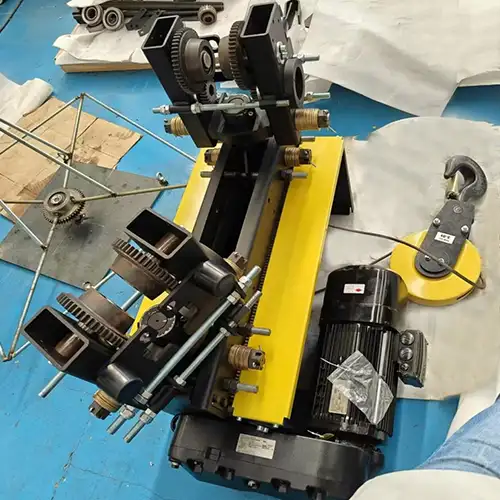
European Style Curved Rail Monorail Electric Hoists
CD & European Style Electric Hoists on Curved Monorail
Comparison of CD electric monorail hoists and European style curved rail hoists, highlighting their advantages, disadvantages, and ideal applications.
CD Electric Monorail Hoists: Advantages
Cost-Effectiveness, Simplicity: CD electric hoists are known for their cost-effectiveness and straightforward design, making them an attractive option for many businesses. Their simpler construction allows for lower initial investment, which is particularly appealing for smaller operations or those with limited budgets. Additionally, the ease of use and maintenance associated with CD hoists means less downtime and lower operating costs. This simplicity makes them suitable for applications where advanced features are not a necessity.
CD Electric Monorail Hoists: Disadvantages
Limited Compatibility with Tight Curves, Less Precision: Despite their advantages, CD electric hoists have limitations when it comes to navigating tight curves. Their design is more suited for straight or gradually curved tracks, making them less effective in environments requiring intricate maneuvers. The lack of precision in handling loads during cornering can lead to inefficiencies and safety concerns, particularly when operating in spaces with tight turns or complex layouts. This makes CD hoists less ideal for operations that demand high levels of accuracy and stability.
CD Electric Monorail Hoists: Ideal Applications
Ideal for Straight or Gradually Curved Tracks: CD electric hoists excel in applications where the track layout is predominantly straight or features gentle curves. Industries that require basic lifting capabilities without the need for extensive maneuverability can benefit from the simplicity and cost-effectiveness of CD hoists. They are commonly used in warehouses, assembly lines, and other environments where load handling does not involve significant lateral movement or sharp turns.
European Style Curved Rail Hoists
Advantages, disadvantages, and ideal applications of European style curved rail hoists for complex monorail systems.
European Style Curved Rail Hoists: Advantages
Better Precision, Flexibility, and Adaptability for Complex Curved Tracks: European style electric hoists are engineered with advanced features that enable better precision and adaptability, making them ideal for complex curved rail systems. Their design incorporates features such as compact configurations, variable frequency drives, and precision handling systems, allowing for smooth transitions through curves. This flexibility is especially beneficial in industries that require frequent changes in direction and load positioning, such as manufacturing and logistics.
European Style Curved Rail Hoists: Disadvantages
Higher Cost, More Complex Installation: One of the primary drawbacks of European style electric hoists is their higher upfront cost compared to CD hoists. The advanced technology and features included in their design contribute to this increased price. Additionally, the installation of European style hoists can be more complex, often requiring specialized knowledge and skills to ensure proper setup. This complexity can lead to longer installation times and increased labor costs, which may deter some businesses from choosing these hoists for their operations.
European Style Curved Rail Hoists: Ideal Applications
Ideal for Applications Needing Smooth, Precise Movements and Complex Curved Paths: European style electric hoists are best suited for applications that demand high levels of precision and smooth movements along complex curved paths. Industries such as automotive assembly, aerospace manufacturing, and heavy equipment handling often benefit from the enhanced control and adaptability these hoists provide. When the smooth handling of loads through tight curves is crucial, European style hoists offer a distinct advantage over their CD counterparts.
Performance Metrics Comparison
Comparison of CD electric hoists and European style hoists on load capacity, speed, precision, and safety features in curved rail operations.
Load Capacity Handling
When comparing load capacity handling, both CD electric hoists and European style electric hoists can accommodate a range of weights, but the efficiency with which they handle loads on curved rails varies significantly.
- CD hoists typically have a set load capacity, which may be limited by their design when navigating curves.
- European style hoists are engineered for dynamic load handling, allowing for more consistent performance even under varying conditions.
Speed and Precision in Curved Rail Operations
Speed and precision are critical performance metrics in curved rail operations.
- CD electric hoists generally operate at lower speeds due to their limitations in navigating tight curves, affecting overall productivity.
- European style hoists, equipped with advanced control systems, maintain higher speeds while ensuring precise movements along curves, ideal for fast-paced environments.
Safety Features and Customization Options
Safety is a paramount concern in industrial operations, and both hoist types offer safety features, but the scope of these features varies.
- CD electric hoists typically have basic safety mechanisms.
- European style hoists include advanced safety features like overload protection, anti-sway technology, and customizable options for specific operational needs.
- This adaptability enhances overall operational safety. Click to check Monorail Overhead Crane for sale: Straight Rail vs Curved Monorail Hoist Crane.
Choosing the Right Electric Hoist for Curved Rail Systems
Selecting the appropriate electric hoist for curved rail systems is a crucial decision that can significantly impact operational efficiency and safety. Various factors should be taken into account to ensure the best fit for your specific needs.
Track Layout and Minimum Turning Radius
- Importance: The design of the track layout is one of the most important factors when choosing an electric hoist. Understanding the minimum turning radius required for the specific hoist type is essential for ensuring optimal performance and efficiency.
- CD Electric Hoists: Traditional hoists are less adaptable to tight curves, ideal for gradual curves or straight sections; may struggle with maneuverability in complex layouts.
- European Style Electric Hoists: Engineered for high adaptability and smooth cornering, capable of navigating tighter curves efficiently, suitable for intricate track layouts.
- Expert Collaboration: Working with hoist system experts can help select a hoist that meets operational requirements while enhancing productivity, safety, and reliability in curved rail applications.
Load Size, Weight, and Nature
- Weight: Heavy items require hoists with higher capacities to lift safely and maintain operational efficiency.
- Size and Shape: Bulky or oversized loads may require wider lifting spans or specialized attachments to navigate turning radii or confined spaces effectively.
- Load Characteristics: Fragile items require hoists with advanced control features such as variable speed controls and soft start mechanisms to minimize damage.
- Irregular Shapes: Loads with irregular shapes may need custom lifting attachments or specialized hoists to ensure stability and prevent tipping or dropping.
Environmental and Space Constraints
- Temperature, Humidity, and Corrosive Substances: Extreme temperatures, moisture, and chemicals can affect hoist performance; select materials and designs suitable for these conditions, such as anti-corrosion or weather-resistant hoists.
- Limited Headroom: Low ceilings may require compact or low-headroom hoist designs, like European-style models, for safe and efficient operations.
- Narrow Aisles: Tight spaces require hoists that can maneuver effectively; compact and adaptable designs improve flexibility and operational efficiency.
Considering track layout, load characteristics, and environmental and spatial constraints ensures that your selected electric hoist performs efficiently, safely, and reliably in curved rail applications.
Environmental and Space Considerations for Hoist Selection
Assessing environmental factors and spatial constraints is critical for choosing an electric hoist that ensures safe, efficient, and long-lasting performance.
Temperature
- Impact: Extreme temperatures, whether hot or cold, can affect hoist performance.
- Considerations: Some materials may become brittle in cold conditions, while others can warp under high heat. Ensure the hoist is rated for the temperature range of your operational environment.
Humidity
- Impact: High humidity can lead to moisture accumulation, increasing the risk of corrosion and electrical failure.
- Considerations: Choose hoists with enhanced anti-corrosion features, such as stainless steel components or specialized coatings, to withstand prolonged exposure to moisture.
Corrosive Substances
- Impact: Exposure to chemicals can compromise hoist integrity.
- Considerations: Opt for hoists made from weather-resistant materials or with specialized coatings to protect against corrosion and chemical damage.
Limited Headroom
- Impact: Low ceilings can restrict lifting operations.
- Considerations: Compact hoist designs, particularly European-style electric hoists, feature low-headroom configurations for safe and efficient operation.
Narrow Aisles
- Impact: Tight spaces can limit hoist maneuverability.
- Considerations: Select compact hoist designs capable of navigating tight corners and curves. European-style hoists often offer greater adaptability in such conditions.
Thorough evaluation of environmental and spatial constraints ensures optimal hoist performance, safety, and longevity, making it a smart investment for your facility.
Budget and Long-term Operational Needs
While initial costs are an important consideration, it's vital to evaluate the long-term operational needs and total cost of ownership associated with each hoist type. CD electric hoists might offer lower upfront costs, but their limitations in navigating curves can lead to decreased efficiency and higher operational costs over time. On the other hand, European style hoists, while more expensive initially, may provide better long-term value through increased efficiency, reduced maintenance, and enhanced safety features. Therefore, a comprehensive analysis of both immediate budget constraints and anticipated future needs is essential to make an informed decision that aligns with your operational goals and financial resources.
When selecting an electric hoist for curved rail systems, the budget is just one aspect of the decision-making process. A thorough evaluation of long-term operational needs and the total cost of ownership (TCO) is crucial for ensuring that your investment aligns with both current and future operational goals.

Initial Costs vs. Total Cost of Ownership
Evaluating both initial purchase costs and long-term operational expenses is essential for selecting the most cost-effective electric hoist solution.
Initial Costs
- Consideration: The upfront price of electric hoists can vary significantly; CD hoists usually have lower initial costs, appealing to businesses with budget constraints.
- Implication: A lower purchase price does not always mean long-term savings; initial cost is important but should not be the sole deciding factor.
Long-term Costs
- Operational Efficiency: CD hoists may face inefficiencies on tight curves, causing longer cycle times, more downtime, and higher labor costs.
- Maintenance Expenses: Lower initial costs can be offset by increased maintenance due to wear from poor curve navigation, frequent repairs, and component replacements, raising total operational costs over time.
Evaluating Long-term Value
Considering long-term efficiency, maintenance, and adaptability helps determine the true value of an electric hoist investment.
Efficiency Gains
- European Style Hoists: Despite a higher initial cost, these hoists excel on curved tracks, providing precise navigation and improved performance in complex rail systems.
- Impact: Enhanced efficiency reduces cycle times, accelerates operations, and may lower labor costs, offering substantial long-term savings.
Reduced Maintenance
- Durability and Reliability: Advanced engineering in European-style hoists ensures longevity, fewer breakdowns, and less frequent maintenance, cutting costs over time.
- Safety Features: Built-in safety mechanisms protect workers and minimize expensive accidents caused by equipment failures.
Alignment with Operational Goals
- Future Needs: Planning for growth or changes in material handling ensures the hoist can adapt to evolving operational requirements.
- Scalability: Selecting a system compatible with existing infrastructure and capable of handling increased loads reduces costs from future upgrades or additional purchases.
In summary, while budgetary constraints are a crucial consideration when selecting an electric hoist, it's vital to take a holistic view of the long-term operational needs and total cost of ownership. Balancing initial costs with future savings from efficiency, reduced maintenance, and safety features will lead to more informed decision-making. A comprehensive analysis will help ensure that you select the right hoist that meets both current and anticipated operational demands, ultimately aligning with your organization's financial resources and operational goals. By investing wisely, you can optimize productivity, enhance safety, and achieve significant long-term value.
Installation and Maintenance of Electric Hoists on Curved Rails
Proper installation and maintenance are critical to ensure safe, efficient, and long-lasting operation of electric hoists on curved rails.
Importance of Proper Track Alignment
Achieving precise alignment of the curved track is essential for optimal hoist performance. Misalignment can cause increased trolley wheel wear, uneven load distribution, and reduced efficiency. Use accurate measuring tools during installation and perform regular checks to maintain alignment over time, especially in high-usage environments.
Ensuring Stability in Curved Path Installations
Stability is vital when installing curved rail systems. Supports and mounting structures must handle forces during hoist operation, particularly on curves. Use robust anchors and brackets, and install rails at the proper angle and curvature to enable smooth transitions and reduce operational risks.
Common Challenges in Installing Curved Rail Systems
Curved rail installations may face challenges such as limited space, existing infrastructure, and the need for specialized equipment. Custom solutions like tailored rail sections or bespoke mounting hardware may be required. A skilled installation team familiar with curved rail systems is essential to ensure safe and effective setup.
Addressing these considerations during installation ensures that electric hoists on curved rails operate safely, efficiently, and with minimal maintenance issues.
Maintenance Tips for Longevity
Regular maintenance is crucial for extending the lifespan and ensuring reliable performance of electric hoists on curved rails.
Routine Inspections for Trolley Systems
Regularly inspect wheels, bearings, and connections for wear or damage. Early detection prevents costly repairs and minimizes downtime. Establishing a consistent inspection schedule ensures systematic maintenance.
Maintaining Curved Rails and Hoist Motors
Check rails for wear, deformation, or corrosion, especially in moist or corrosive environments. Service hoist motors per manufacturer guidelines, including lubrication and cleaning, to prevent overheating and failures.
Preventative Measures to Avoid Wear
Apply proper lubricants to reduce friction, keep rails clean, and monitor load capacities to prevent overloading. Train operators on correct procedures for curved rails to minimize damage and extend system life.
Proper installation combined with routine maintenance ensures safe, efficient, and long-lasting operation of electric hoists on curved rails.
Applications and Case Studies
Electric hoists on curved rails are widely applied across industries, improving efficiency, precision, and space utilization in complex material handling environments.
Automotive Industry
Case Study: Efficient Use of Curved Rails in Automotive Assembly Lines
A major automobile manufacturer implemented electric hoists on curved rails to streamline assembly line operations and optimize workspace.
Improved Workflow: Curved rails allowed hoists to move seamlessly around workstations, transporting engines and chassis efficiently.
Space Optimization: Reduced equipment footprint while maintaining high lifting performance.
Precision Control: Integration of variable frequency drives (VFD) enabled smooth speed adjustments and minimized operational shocks.
Enhanced Safety: Stable movement reduced risks, allowing operators to focus on assembly tasks.
This implementation resulted in faster production cycles and improved overall efficiency.
Shipbuilding and Aerospace
Case Study: Precision Handling on Curved Tracks for Large Components
A leading shipyard adopted curved rail electric hoists to manage oversized components during construction.
Efficient Material Flow: Hoists transitioned smoothly between work zones, reducing reliance on ground equipment.
Improved Positioning: Allowed closer placement to assembly points, minimizing handling time.
High Precision: Advanced controls ensured accurate alignment of large components such as hull sections.
Reduced Delays: Streamlined operations led to faster turnaround times.
This solution significantly enhanced productivity in demanding heavy industry environments.
Warehousing and Manufacturing
Case Study: Maximizing Space with Curved Rails in Tight Workspaces
A manufacturing facility implemented curved rail hoists to overcome space limitations and improve material handling.
Space Efficiency: Curved rails enabled navigation around obstacles without occupying floor space.
Flexible Operations: System adapted easily to changing workflows and storage layouts.
Reduced Manual Handling: Improved safety by minimizing the need for manual transport in confined areas.
Increased Productivity: Faster material movement improved operational efficiency.
This approach demonstrated how curved rail hoist systems can transform constrained industrial environments.
These applications demonstrate the versatility and effectiveness of electric hoists on curved rails. From automotive assembly to shipbuilding and warehousing, the integration of curved rail systems enhances productivity, safety, and operational efficiency across a wide range of industries.
Conclusion: Get Your Customized Monorail Electric Hoist
The integration of electric hoists on curved rails presents a transformative approach to material handling across various industries. This article has explored the different types of electric hoists, their key features, and their applications, highlighting the significant benefits they offer in optimizing workflows, enhancing safety, and maximizing space.
Electric hoists on curved rails facilitate smoother operations in environments where traditional straight rail systems may fall short. The distinction between CD electric hoists and European-style electric hoists underscores the need to select the right equipment based on specific operational requirements. While CD electric hoists offer cost-effectiveness and simplicity, European-style hoists provide enhanced precision and adaptability for complex curved paths. Key features such as smooth cornering, load capacity considerations, and advanced control systems play a vital role in the performance of these hoists, ensuring efficient and safe operations.
The electric hoists on curved rails looks promising, driven by several emerging trends:
- Advances in Automation and AI-Driven Hoist Control: The integration of automation and artificial intelligence (AI) is set to revolutionize the operation of electric hoists. With the use of smart sensors and AI algorithms, hoists can be programmed to perform complex tasks autonomously, improving efficiency and minimizing human error. This trend is expected to enhance safety, as automated systems can continuously monitor load conditions and adjust operations in real-time.
- The Growing Need for Flexible Rail Systems in Modern Industries: As industries increasingly prioritize flexibility and adaptability, the demand for curved rail systems will continue to rise. These systems offer the versatility needed to accommodate changing production layouts and diverse material handling needs. The ongoing development of modular and customizable rail systems will further enhance the capabilities of electric hoists, allowing for seamless integration into various industrial environments.
In conclusion, electric hoists on curved rails are set to become integral to modern industrial operations, providing solutions that enhance efficiency, safety, and flexibility. As technology continues to advance, these systems will likely evolve, offering even more innovative features that meet the demands of today's dynamic manufacturing landscape. Embracing these advancements will be crucial for businesses seeking to maintain a competitive edge in their respective industries.

Yuantai Cranes
Overhead Crane Manufacturer with CE, ISO, SGS, CNEX Certificates.
- Main Specifications - Capacity: 0.5–550 tons | Span: up to 40m | Speed: 0.8–12 m/min | Duty: A3–A7 | Power: 380–690V, 50/60Hz | Control: pendant/remote/cabin
- Full engineering: FEA/PLC/VFD + in-house build + global delivery + on-site support, for workshops, factories, EPC contractors, industrial projects, etc.
- Support: design, manufacturing, testing, service – end-to-end, customized lifting solutions worldwide.
How to Get an Accurate Crane Price for Your Application?
Tips: Copy the spec list, fill in your details, and paste it into the form on the right/ down-below for a quick price.
- Crane type:_____ . (e.g., overhead crane, gantry crane, jib crane)
- Max weight to lift:_____ tons. (e.g., 2t, 5t, 10t, 20t, 50t)
- Lifting height:_____ m. (How high does the hook need to reach?
- Workshop width (span):_____ m . (Distance between the two crane rails)
- Travel distance:_____ m . (How long does the crane need to move along the runway?)
- Control type:_____. (Pendant / remote / cabin Control)
- Power supply:_____. (Local voltage & frequency – e.g., 380V, 50Hz, 3-phase)
- What will it be used for?_____ (e.g., steel fabrication, concrete products, mold handling, general manufacturing, etc.)
- Any special requirements?_____ (e.g., extreme temperature, dusty or explosive environment, special paint color, etc.)
Just leave a message via the contact form and our hoist and crane engineer will contact you with in 24working hours.
Get Your Custom Quote–Quick & Easy
Fill in what you know. Skip what you don't – we'll help.Any question will be reply with 24 working hours