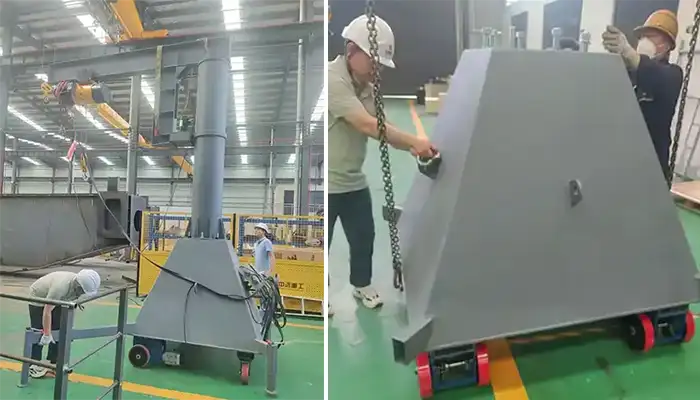
2T Mobile Jib Crane for India | 4.2m Reach, 3m Lift Height
Content Quick Link
2 Ton Mobile Jib Crane for India: A Practical Lifting Solution for Flexible Workshop Operations– 4.2m Reach, 3m Lift Height, 415V/50Hz/3P
Project Overview
A manufacturing workshop in India contacted us on 23 April 2026 seeking a practical lifting solution for daily material handling and equipment maintenance tasks. The customer needed a crane that could be used in different areas of the workshop without investing in permanent crane structures or making changes to the building. After reviewing the working conditions, lifting requirements, and available floor space, a BZ + CD Mobile Jib Crane was selected as the most suitable option. Unlike a fixed pillar jib crane, this mobile jib crane can be moved to different workstations when needed. For workshops where production layouts change from time to time, this type of flexibility is often more useful than installing a stationary lifting system.
Customer Information
- Country: India
- Inquiry Date: 23 April 2026
- Equipment Delivered: BZ + CD Mobile Jib Crane
- Application: Workshop material handling and equipment maintenance
- Project Objective: Provide a movable lifting solution for multiple workstations without permanent installation
Customer's Operating Environment
The customer operates a workshop where lifting tasks occur throughout the day. Components, machine parts, tools, and maintenance equipment frequently need to be moved between different work areas.
In many Indian workshops, floor space is valuable. Business owners often prefer equipment that can serve several locations rather than installing separate lifting devices for each workstation. This customer had a similar requirement.
Some of the daily handling activities included:
- Loading and unloading machine components
- Positioning parts during maintenance work
- Handling fabricated steel components
- Moving equipment between workstations
- Assisting assembly and repair operations
The loads were not concentrated in one location. Instead, lifting points were spread across the workshop. Because of this, a traditional overhead crane system would have increased project costs without delivering additional value.
Why a Mobile Jib Crane Was Considered
During discussions with the customer, several concerns were raised.
The workshop management wanted a solution that could be installed quickly. They also wanted to avoid civil construction work, concrete foundations, and structural modifications.
To put it simply, they needed a crane that could start working as soon as possible and adapt to future workshop changes.
Key requirements included:
- Flexible lifting coverage
- Easy relocation between workstations
- Low installation cost
- Reliable lifting performance
- Compatibility with India's 415V industrial power supply
- Simple maintenance procedures
These requirements are common among Indian manufacturing companies, fabrication workshops, engineering contractors, and machine maintenance facilities.
Equipment Selected
The final solution was a 2 ton mobile jib crane equipped with a CD electric wire rope hoist.
This configuration combines the advantages of a portable jib crane, jib crane on wheels, and conventional workshop lifting equipment.
Main specifications included:
- Capacity: 2 Ton
- Jib Arm Reach: 4.2 m
- Lifting Height: 3 m
- Power Supply: 415V / 50Hz / 3 Phase
- Hoist Type: CD Electric Wire Rope Hoist
- Crane Type: Mobile Jib Crane
- Installation Method: Mobile Base Design
The 4.2-meter working radius allows the crane to cover a useful operating area around machines, maintenance stations, and assembly benches.
Meanwhile, the 3-meter lifting height provides sufficient hook travel for handling equipment, machine parts, and industrial materials commonly found in workshops.
Project Objective
The primary goal was straightforward.
The customer wanted a portable material handling crane that could improve lifting efficiency while keeping investment costs under control.
The selected 2 ton jib crane helped achieve this objective by providing:
- Multi-location lifting capability
- Reduced manual handling
- Faster movement of materials
- No requirement for runway beams
- No requirement for permanent foundations
- Lower installation expenses
- Greater flexibility for future workshop expansion
For many Indian businesses, this approach makes practical sense. Instead of modifying the building to fit the crane, the crane is selected to fit the existing workshop.
That was exactly the thinking behind this project.
Why the Customer Needed a Mobile Jib Crane
The customer's workshop handled a variety of lifting tasks every day. Machine parts, fabricated components, maintenance tools, and production materials needed to be moved regularly between different work areas. At first glance, installing a conventional overhead crane might seem like a possible solution. However, after evaluating the workshop layout and daily operations, it became clear that a more flexible lifting system would better match the customer's actual requirements. The customer was looking for a solution that could support current production needs while also allowing room for future changes. This is a common concern among many Indian manufacturers, where workshop layouts often evolve as new equipment is added or production volumes increase. Several operational challenges influenced the crane selection process.
Multiple Lifting Locations Across the Workshop
One of the biggest challenges was that lifting activities were not concentrated in a single area.
Operators needed lifting assistance at multiple workstations throughout the day. Materials were frequently transferred between machines, maintenance bays, assembly areas, and storage locations.
Typical handling tasks included:
- Moving machine components for repair and servicing
- Positioning fabricated steel parts during assembly
- Loading and unloading materials near production equipment
- Handling spare parts and maintenance tools
- Supporting equipment installation work
Because lifting points were spread throughout the workshop, a fixed lifting solution would leave some areas without adequate coverage.
The customer needed a mobile jib crane that could be repositioned whenever production requirements changed.
Avoiding Civil Construction and Building Modifications
Like many workshop owners in India, the customer wanted to improve material handling without starting a construction project.
Management specifically wanted to avoid:
- Foundation excavation work
- Concrete foundation pouring
- Structural steel support installation
- Building modifications
- Overhead crane runway beams
- Production interruptions during installation
In many cases, civil work can cost almost as much as the lifting equipment itself. More importantly, construction activities can disrupt production schedules.
The customer preferred a lifting solution that could be deployed quickly and begin operating without major site preparation.
This requirement made a portable jib crane a practical option.
Limited Workshop Space
Available floor space was another important consideration.
The workshop contained production equipment, maintenance areas, workbenches, and material storage zones. Space was already being used efficiently, leaving little room for large lifting systems.
The customer needed equipment that could:
- Operate in confined areas
- Provide sufficient lifting coverage
- Maintain safe operator access
- Avoid obstructing production activities
A compact jib crane on wheels offered a good balance between lifting capability and space utilization.
With a 4.2-meter reach, the crane could serve a useful working area without requiring a large installation footprint.
Need for Greater Operational Flexibility
Workshop managers also anticipated future changes in production arrangements.
New machines could be added. Existing workstations might be relocated. Material flow patterns could change as the business expanded.
Rather than installing a fixed crane that would remain in one location permanently, the customer wanted equipment that could adapt alongside the workshop.
Their priorities included:
- Flexible workstation coverage
- Easy equipment relocation
- Support for changing production layouts
- Long-term usability
- Better utilization of lifting equipment
A 2 ton mobile jib crane addressed these concerns by allowing the lifting system to move where it was needed rather than forcing operations to work around a fixed crane location.
Why a Mobile Jib Crane Became the Preferred Solution
After reviewing all requirements, the customer's priorities became clear.
They needed a lifting solution that could:
- Serve multiple workstations
- Reduce manual material handling
- Fit within existing workshop space
- Avoid costly building modifications
- Operate on standard 415V industrial power
- Adapt to future production changes
A mobile jib crane, also known as a portable jib crane or movable jib crane, met these requirements more effectively than a fixed pillar crane or overhead crane system.
For this particular workshop, flexibility was just as important as lifting capacity. The ability to move the crane between work areas ultimately became one of the key reasons behind the final equipment selection.
Recommended Solution: 2 Ton Mobile Jib Crane
After reviewing the workshop layout, lifting points, and daily handling routine, a 2 ton mobile jib crane with a portable base structure was recommended.
The key requirement was simple: the customer did not want a fixed installation that locks the crane into one position. Instead, they needed a lifting system that could move with the workflow inside the workshop.
Unlike a traditional pillar-mounted jib crane, this jib crane on wheels (also referred to as a portable jib crane or movable jib crane) can be repositioned based on where lifting work is required. In practical workshop conditions, this means the crane follows the job instead of forcing the job to follow the crane.
For Indian manufacturing environments where production layouts often change, this type of flexibility helps keep operations practical and cost-focused. There is no need for repeated structural changes or additional lifting points across the workshop.
The final solution was based on the BZ + CD crane configuration, which is widely used in general fabrication, maintenance workshops, and light-to-medium industrial handling tasks.
Technical Specifications
The selected system was configured to match both the lifting requirement and the electrical standard used in Indian industrial facilities.
| Item | Specification |
|---|---|
| Crane Type | Mobile Jib Crane |
| Model | BZ + CD |
| Safe Working Load (SWL) | 2 Ton |
| Jib Arm Reach | 4.2 m |
| Lifting Height | 3 m |
| Hoist Type | CD Wire Rope Electric Hoist |
| Rotation Method | Manual / Slewing Jib Operation |
| Power Supply | 415V / 50Hz / 3 Phase |
| Installation Type | Portable Mobile Base (Jib Crane on Wheels Design) |
| Application | Workshop Material Handling and Maintenance Work |
The 4.2 meter outreach provides enough working coverage for typical workshop operations such as machine loading, part positioning, and maintenance lifting. The 3 meter lifting height is suitable for most standard industrial components without requiring additional structural adjustments.
From a practical point of view, this mobile jib crane solution is designed for day-to-day workshop use, where reliability, simple operation, and flexibility matter more than complex system configuration.
Why a Mobile Jib Crane Was the Right Choice
In this project, the final decision was not based only on lifting capacity. It was based on how the workshop actually runs day to day. In many Indian manufacturing units, especially small and mid-size workshops, the real priority is simple: keep production moving without adding unnecessary construction work or long shutdown periods. The 2 ton mobile jib crane offered exactly that kind of practical balance.
Flexible Lifting Wherever Needed
One of the main reasons the customer selected a mobile jib crane / portable jib crane was flexibility.
Instead of being fixed at one location, the crane can be moved closer to the active working area. In a real workshop environment, this makes a clear difference.
When the job moves, the crane moves with it.
Practical benefits in daily operation:
- Faster movement of machine parts between workstations
- Less manual lifting and reduced strain on workers
- Smoother workflow during maintenance and assembly tasks
- Better use of available floor space without blocking production paths
In many Indian workshops, space is already fully used. So equipment that adapts to the workflow—not the other way around—tends to deliver better day-to-day results.
No Expensive Infrastructure Modifications
A key decision factor for the customer was avoiding civil and structural work. This is a common requirement in India, especially for workshops that want to expand capacity without interrupting production.
The jib crane on wheels / movable jib crane design removes the need for major installation work.
What the customer avoided:
- No overhead runway beam system
- No foundation excavation or concrete casting
- No structural steel extension
- No long production downtime for installation
This keeps the setup process simple. The crane can be put into service quickly, which is often important for workshop schedules that are already tight.
4.2 Meter Working Radius for Practical Coverage
The 4.2 meter jib arm length was selected to match typical workshop spacing between machines and working zones.
It is not oversized, and not too limited either. It is a practical reach for everyday industrial use.
Operational advantages:
- Covers multiple machines within a single radius
- Reduces the need to reposition materials manually
- Improves consistency in material flow between stations
- Suitable for maintenance zones and assembly areas
For most Indian fabrication and engineering workshops, this working radius fits standard layouts without requiring redesign of the shop floor.
Reliable CD Electric Wire Rope Hoist
The crane was paired with a CD electric wire rope hoist, a widely used lifting component in India's industrial sector.
It is selected not for complexity, but for reliability and service convenience.
Why Indian buyers often prefer CD hoists:
- Proven long-term performance in workshop environments
- Spare parts are widely available in local markets
- Maintenance can be handled by in-house technicians
- Operators are already familiar with its operation style
- Stable performance under regular daily lifting cycles
In practical terms, it reduces the learning curve and keeps maintenance straightforward, which is important for workshops without dedicated crane specialists.
Summary of Why This Solution Fits the Project
The combination of a mobile jib crane, portable jib crane design, and CD hoist system provided a balanced solution:
- Flexible movement between work areas
- No permanent installation requirements
- Practical working radius for real workshop layouts
- Simple operation and maintenance
- Suitable for 415V industrial power systems in India
In this case, the value of the solution was not in complexity. It was in how naturally it fits into everyday workshop work without changing how the business already operates.
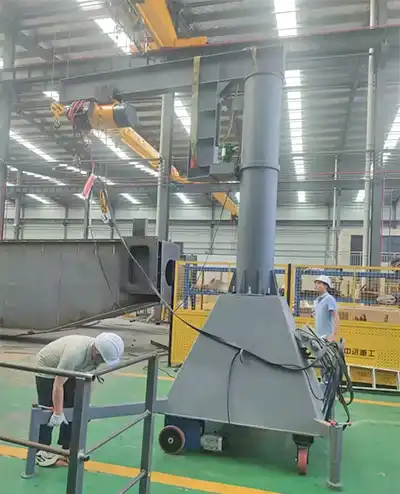
2T Mobile Jib Crane for India – 4.2m Reach, 3m Lift Height, 415V/50Hz/3P
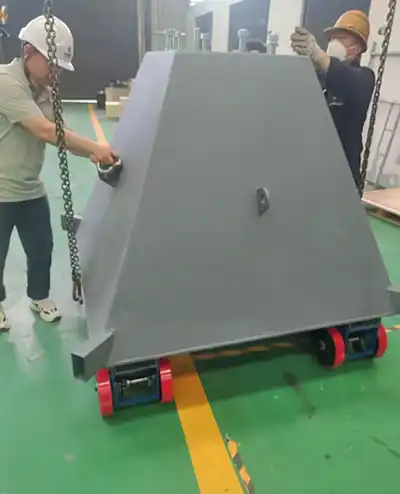
Foundations of the 2 ton mobile jib crane on wheels
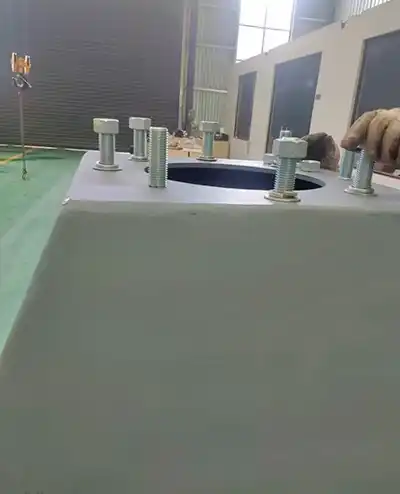
Detailes of the foundation bolts for the 2T Mobile Jib Crane for India – 4.2m Reach, 3m Lift Height, 415V/50Hz/3P
Key Features of The 2 Ton Portable Jib Crane
This 2 ton mobile jib crane was designed for practical workshop use, where equipment needs to be simple, durable, and easy to move when production demands change. In Indian workshops especially, equipment is expected to "fit into daily work" without creating extra handling steps.
Mobile Base Design
The crane is built on a mobile base structure, allowing it to be moved between different working zones inside the workshop.
Practical points:
- Can be positioned near different machines
- Supports multi-workstation lifting tasks
- Reduces dependency on fixed lifting points
- Suitable for flexible workshop layouts
This is one of the key reasons many buyers also search for terms like portable jib crane, jib crane on wheels, and movable jib crane for workshop use in India.
Compact Footprint
The structure is designed to occupy limited floor space while still providing stable lifting performance.
What this means in real workshop use:
- Does not block production movement paths
- Can operate in narrow working areas
- Fits into existing workshop layouts without redesign
- Suitable for small and medium fabrication units
For Indian SMEs, space efficiency is often as important as lifting capacity.
415V Industrial Power Supply Compatibility
The system is designed for 415V / 50Hz / 3-phase industrial power, which matches standard electrical setups used across Indian manufacturing facilities.
Operational advantages:
- Easy integration into existing power systems
- No need for special electrical modification
- Stable performance under workshop load conditions
- Suitable for continuous daily operation
This makes the crane directly usable in most Indian factories without additional electrical upgrades.
Robust Steel Structure
The crane structure is built for regular industrial use, not occasional lifting.
Key points:
- Designed for repeated daily operation
- Stable under 2 ton working load
- Suitable for workshop environments with dust, vibration, and frequent movement
- Strong structural support for jib arm rotation and lifting cycles
This ensures the crane remains reliable under typical Indian workshop conditions.
Low Maintenance Requirements
The system is designed with simplicity in mind, which directly reduces maintenance workload.
Benefits in operation:
- Fewer complex mechanical parts
- Easy inspection and servicing
- Lower downtime during maintenance
- Reduced long-term operating cost
For many Indian workshops, maintenance simplicity is a practical advantage because it reduces dependency on external service teams.
Advantages for Indian Manufacturing Businesses
In India's manufacturing and fabrication sector, investment decisions are usually based on long-term practicality rather than equipment complexity. This mobile jib crane solution aligns well with that approach.
Reduced Capital Investment
Compared with overhead crane systems or fixed gantry crane installations, a portable jib crane requires much lower infrastructure cost.
Key points:
- No runway beam system required
- No heavy civil foundation work
- Lower installation cost
- Faster deployment into production
This helps small and medium workshops control initial investment while still improving lifting capability.
Increased Operational Flexibility
A major advantage is the ability to adapt to changing workshop layouts.
Practical benefits:
- Crane can be relocated as production changes
- One crane can serve multiple work areas
- Suitable for expanding workshops
- Reduces need for multiple fixed cranes
This flexibility is especially useful in Indian workshops where production lines often evolve over time.
Improved Workplace Safety
Material handling is a daily risk area in workshops. Using a mechanical lifting system reduces manual handling.
Safety improvements include:
- Reduced manual lifting of heavy components
- More controlled load movement
- Lower risk of workplace injury
- Safer handling of machine parts and steel components
This supports safer working conditions for operators and technicians.
Faster Return on Investment
Because installation is simple and operational benefits are immediate, the payback period is often shorter.
Contributing factors:
- Low installation cost
- Immediate productivity improvement
- Reduced manpower requirement for lifting tasks
- Better workflow efficiency
For many Indian businesses, this makes the 2 ton mobile jib crane a practical investment rather than a heavy capital project.
Frequently Asked Questions About Mobile Jib Cranes
Q1: Why choose a mobile jib crane instead of an overhead crane?
A: A mobile jib crane is used when you need simple and flexible lifting in a workshop without installing a full overhead crane system.
- It is a practical choice for workshops with limited space or changing work areas.
- No need for runway beams, building changes, or long installation work.
- It works well when lifting is needed in different spots, not the whole factory area.
Q2: What is the difference between a mobile jib crane and a fixed jib crane?
A: A fixed jib crane stays in one place, while a mobile jib crane can be moved inside the workshop.
- A fixed jib crane is good for one working area only.
- A mobile or jib crane on wheels can be used in different locations.
- This is helpful when machines or workstations are not in one fixed layout.
Q3: Is a 2 ton portable jib crane suitable for Indian workshops?
A: Yes, a 2 ton portable jib crane is commonly used in many Indian workshops.
- It is suitable for machine parts, steel pieces, and maintenance work.
- Often used in fabrication shops, repair workshops, and small factories.
- It matches the typical lifting needs of medium workshop operations in India.
Q4: Can the crane work with India's standard power supply?
A: Yes, it works with 415V, 50Hz, 3-phase power used in most Indian factories.
- No special electrical setup is needed.
- Easy to connect in normal industrial workshops.
- Suitable for daily use in manufacturing environments.
Q5: What industries use mobile jib cranes in India?
A: They are used in many workshops where lifting is needed in different work areas.
- Fabrication and engineering workshops
- Automobile and spare parts factories
- Machine repair and maintenance shops
- Small and medium manufacturing units
- Warehouses and assembly areas
Q6: What is the main advantage of a jib crane on wheels?
A: The main advantage is that it can be moved to different places in the workshop.
- One crane can serve multiple workstations.
- Saves space and reduces the need for multiple fixed cranes.
- Makes daily material handling easier and more flexible.
Why More Indian Businesses Are Choosing Mobile Jib Cranes
In many Indian workshops today, decisions around lifting equipment are no longer just about capacity. They are more about how smoothly the system fits into daily production, how quickly it can be installed, and how much value it brings without locking the business into heavy infrastructure work.
This is where the mobile jib crane, portable jib crane, and movable workshop crane system are increasingly being selected across fabrication units, engineering workshops, and small manufacturing plants.
Instead of committing to permanent structural changes, many business owners now prefer lifting solutions that can adapt as production needs change. In practical terms, this means the crane should support today's workflow but also remain useful when the workshop layout changes next year or production expands.
A jib crane on wheels or mobile design fits this requirement well. It allows lifting support to be moved closer to the job, rather than forcing the job to fit a fixed lifting point.
For most Indian manufacturers, especially SME owners, this approach is straightforward: reduce unnecessary construction work, keep production running, and invest in equipment that can be used in multiple areas of the workshop.
In many cases, this is not only a technical choice. It is a financial and operational decision that focuses on practical return, long service life, and stable daily use rather than complex systems that take time and cost more to implement.
Need a Mobile Jib Crane for Your Workshop?
Selecting the right lifting equipment is not only about choosing a capacity number. In real workshop conditions, factors like working radius, lifting height, power supply, and how often the equipment will move between workstations are equally important.
Whether your requirement is a 1 ton mobile jib crane for light workshop use, a 2 ton portable jib crane for general fabrication work, or a 5 ton workshop jib crane for heavier maintenance tasks, the selection needs to match actual operating conditions.
In Indian industrial environments, common requirements usually include:
- 415V / 50Hz three-phase power compatibility
- Compact installation suitable for existing workshop layouts
- Easy movement for multi-workstation lifting
- Simple maintenance structure for in-house servicing
- Stable performance for daily production cycles
Our engineering support focuses on providing customized mobile jib crane solutions, including jib crane on wheels systems and portable material handling cranes, designed according to real workshop layouts, load requirements, and local operating conditions in India.
The goal is not just to supply a crane, but to provide a lifting setup that fits into your production flow without disruption, and continues to support your workshop as it grows and changes over time.

Article by Bella ,who has been in the hoist and crane field since 2016. Bella provides overhead crane & gantry crane consultation services for clients who need a customized overhead travelling crane solution.Contact her to get free consultation.
Yuantai Cranes
Overhead Crane Manufacturer with CE, ISO, SGS, CNEX Certificates.
- Main Specifications - Capacity: 0.5–550 tons | Span: up to 40m | Speed: 0.8–12 m/min | Duty: A3–A7 | Power: 380–690V, 50/60Hz | Control: pendant/remote/cabin
- Full engineering: FEA/PLC/VFD + in-house build + global delivery + on-site support, for workshops, factories, EPC contractors, industrial projects, etc.
- Support: design, manufacturing, testing, service – end-to-end, customized lifting solutions worldwide.
How to Get an Accurate Crane Price for Your Application?
Tips: Copy the spec list, fill in your details, and paste it into the form on the right/ down-below for a quick price.
- Crane type:_____ . (e.g., overhead crane, gantry crane, jib crane)
- Max weight to lift:_____ tons. (e.g., 2t, 5t, 10t, 20t, 50t)
- Lifting height:_____ m. (How high does the hook need to reach?
- Workshop width (span):_____ m . (Distance between the two crane rails)
- Travel distance:_____ m . (How long does the crane need to move along the runway?)
- Control type:_____. (Pendant / remote / cabin Control)
- Power supply:_____. (Local voltage & frequency – e.g., 380V, 50Hz, 3-phase)
- What will it be used for?_____ (e.g., steel fabrication, concrete products, mold handling, general manufacturing, etc.)
- Any special requirements?_____ (e.g., extreme temperature, dusty or explosive environment, special paint color, etc.)
Just leave a message via the contact form and our hoist and crane engineer will contact you with in 24working hours.
Get Your Custom Quote–Quick & Easy
Fill in what you know. Skip what you don't – we'll help.Any question will be reply with 24 working hours