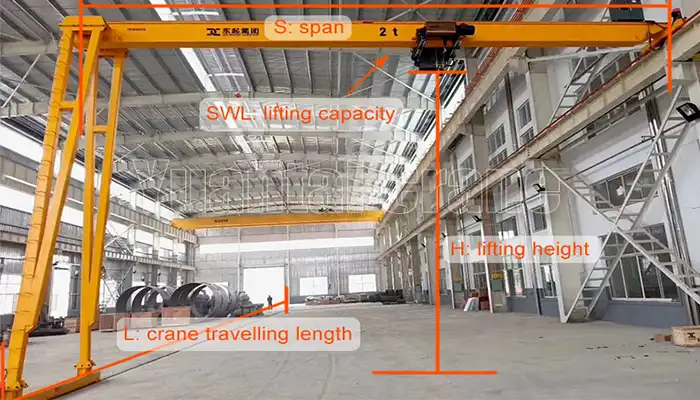
Rail vs Trackless Gantry Crane Cost Guide & Comparison
Content Quick Link
In industrial crane projects, cost is not only about the crane itself. In workshops and production yards, the biggest spending often comes from how the system is built on the ground, how it moves, and how stable the production layout is over time. When buyers compare a rail mounted semi gantry crane system with a trackless semi gantry crane system, they are actually comparing two different engineering and investment approaches. One is fixed and infrastructure-based. The other is flexible and floor-mobility based. The mobility design directly decides how much you spend before the crane even starts working. In practical industrial projects, this is often underestimated at the beginning stage. Rail mounted semi gantry crane system: Trackless semi gantry crane system: So the question is not only about equipment. It is about how fixed or flexible the production system should be. In industrial planning, experienced buyers rarely focus only on the quotation price. They look at total lifecycle cost, often called Total Cost of Ownership (TCO). This includes: A lower purchase price does not always mean lower total project cost. In steel workshops, fabrication yards, precast concrete plants, and logistics facilities, layout changes are common. Sometimes production lines expand. Sometimes material flow changes. So the cost structure is directly tied to operational ity, not only engineering design. To make it clear: In industrial practice, cost analysis is not about choosing the cheapest option. It is about choosing the system that avoids unnecessary reconstruction, downtime, and layout modification later. Before comparing cost, installation, or lifecycle performance, it is necessary to clearly define what each system actually is in industrial use. In projects, misunderstanding the structure of the crane system often leads to wrong budget planning or unsuitable workshop layout design. A rail-mounted semi gantry crane system is built on a fixed traveling path. The crane moves along steel rails or concrete runway beams that are embedded into the workshop foundation. Once installed, the travel route does not change easily. This type of system is commonly used where production flow is stable and repetitive. In many steel processing lines or heavy fabrication workshops, the crane follows a fixed direction between loading, processing, and storage areas. In practical industrial terms, this system is often chosen when the workshop design is already finalized and expected to remain unchanged for many years. A trackless semi gantry crane system operates without embedded rails. Instead, it uses ground wheel traveling design, allowing the crane to move directly on the workshop floor. The movement is not limited to a fixed track, which gives more freedom in positioning. This system is often used in facilities where production areas may change, expand, or be reorganized. It is also common in maintenance workshops and multi-zone material handling environments where flexibility is more important than fixed routing. In practical application, this system is preferred when the workshop cannot commit to a fixed crane path or when future expansion is expected. When comparing rail-mounted and trackless semi gantry crane systems, the evaluation is not only about equipment design. It also involves how the workshop is built and how production will operate over time. In practical engineering decisions, this comparison sets the foundation for all later cost analysis, including installation cost, maintenance planning, and long-term expansion strategy. In procurement decisions for semi gantry crane systems, the first budget block is always the initial capital expenditure (CAPEX). This is where rail-mounted systems and trackless systems start to show clear cost differences. The important point is that the crane price alone does not reflect the project cost. The ground structure, installation process, and commissioning time all contribute to the final investment. A rail-mounted semi gantry crane system carries a heavier infrastructure burden at the beginning stage. Most of the cost is not in the crane itself, but in preparing the workshop to support a fixed rail traveling system. In practical industrial projects, the following cost items are typically involved: Overall, rail systems involve a higher upfront CAPEX because the crane is integrated into a permanent structural system. A trackless semi gantry crane system shifts most of the cost away from civil engineering and toward equipment configuration. The installation process is generally simpler and faster, especially in existing workshops. The main cost elements include: In practical industrial use, this reduces early-stage investment pressure, especially in projects where workshop layout may still change. When comparing both systems in projects, the difference is not only “which is cheaper,” but “where the money is spent.” In industrial procurement, this stage often determines whether a project is considered infrastructure-heavy investment or flexible equipment-based investment. In industrial crane projects, cost is not only about equipment price, but also about infrastructure, installation, and long-term operation efficiency. Crane mobility design directly affects total project cost before operation even begins. This cost factor is often underestimated in early project planning. The decision is about production stability vs operational flexibility. Experienced industrial buyers evaluate full lifecycle cost, not just initial quotation. A lower purchase price does not always mean lower total project cost. Industrial workshops often experience layout changes, production expansion, and workflow adjustments. Cost structure is directly linked to operational stability and future adaptability. The correct choice is not the cheapest option, but the one that avoids future reconstruction, downtime, and layout changes. Installation time is often underestimated in semi gantry crane projects, but in industrial operations, it directly translates into production loss, scheduling pressure, and labor idle cost. Whether a system uses rail installation or a trackless design, the difference in commissioning time can change the overall project economics quite noticeably. A rail-mounted semi gantry crane system typically requires a multi-stage construction process. Each stage depends on the completion and accuracy of the previous one, which naturally extends the total project timeline. The installation sequence usually includes: Because of this layered process, the installation period is longer and more sensitive to delays. In industrial projects, this creates a clear cost impact: In practical terms, rail systems carry a higher opportunity cost because the factory is often partially or fully affected during installation. A trackless semi gantry crane system follows a simpler installation logic. Instead of building fixed rail infrastructure, the system relies on ground wheel movement over existing workshop floors. The installation process is usually more direct: In many cases, the system can be commissioned without long-term shutdown of the workshop. This is especially important in facilities that operate continuous production schedules. The practical benefits include: In industrial settings, this reduces the hidden cost of downtime, which is often more critical than the equipment price itself. When comparing both systems from an installation time perspective, the difference is not only technical but operational. In many workshops, especially where steel processing or batch manufacturing is continuous, even a short production stop can affect delivery schedules. That is why installation time is often treated as part of the total project cost structure, not just a construction detail. From a practical engineering point of view, the decision often comes down to one question: whether the project can afford a longer infrastructure build period or needs faster operational readiness with minimal downtime. In industrial crane operation, maintenance cost is often more important than the initial purchase price. Over time, the system that looks cheaper at the beginning can become more expensive if it requires frequent adjustment, repair, or infrastructure correction. This is where rail-mounted and trackless semi gantry crane systems show clear differences in operational expenditure (OPEX). A rail-mounted semi gantry crane system is not only a mechanical system but also a fixed infrastructure system. Because of this, maintenance responsibility is shared between the crane components and the ground structure. Typical maintenance requirements include: In practical workshops, this means maintenance is not only mechanical—it is also structural. That is why rail systems usually involve higher long-term OPEX, especially in heavy-duty or continuous production environments. A trackless semi gantry crane system shifts maintenance focus away from infrastructure and toward mobile components and floor conditions. Since there are no embedded rails, the maintenance scope becomes simpler in terms of structural work. Main maintenance activities include: In practical industrial use, this makes maintenance more predictable and easier to manage, especially in workshops where layout flexibility is more important than fixed heavy-duty continuous operation. From a lifecycle cost perspective, the difference is not only about how often maintenance is needed, but what type of maintenance is required. In industrial environments such as steel workshops or fabrication yards, rail systems tend to require more long-term structural attention, while trackless systems shift maintenance responsibility toward replaceable parts. This difference directly affects long-term operating budget planning, especially when evaluating crane systems for multi-year continuous use. In industrial planning, the initial crane installation is only the first step. Workshops rarely stay unchanged. Production capacity increases, product types shift, or new work zones are added. Because of this, scalability becomes a direct cost factor, not just a design consideration. The difference between rail mounted semi gantry crane systems and trackless semi gantry crane systems becomes more obvious over time, especially when expansion is required. A rail mounted semi gantry crane system is physically locked into the workshop infrastructure. Once rails are embedded into the foundation and aligned, the system becomes part of the building structure. This gives stability, but it also makes future expansion more complex and costly. When expansion is needed, it usually involves: Because of these requirements, expansion is not just an equipment upgrade. It becomes a construction-level modification project. In practical terms: This makes rail systems more suitable for environments where production scale is stable and long-term layout planning is already well defined. A trackless semi gantry crane system follows a different logic. Instead of being tied to fixed infrastructure, it operates as a mobile unit within the workshop environment. This allows expansion to happen in a more modular way. Common expansion methods include: This approach reduces the need for construction work during expansion. In practical industrial use: From a lifecycle investment viewpoint, scalability affects long-term budgeting more than initial installation cost. In industrial environments such as fabrication workshops, logistics yards, and modular manufacturing plants, expansion flexibility often determines whether future growth is smooth or infrastructure-heavy. This is why scalability is not just about adding capacity—it is about how easily the system can adapt without rebuilding the workshop structure. In industrial crane investment, cost is not only about CAPEX and OPEX. There is another layer that often decides the financial outcome over time: risk exposure related to layout stability, production changes, and asset utilization. When comparing rail mounted semi gantry crane systems and trackless semi gantry crane systems, this risk factor becomes very practical in workshop operation. A rail mounted semi gantry crane system requires commitment at the early stage. Once the rails are embedded, aligned, and tied into the concrete foundation, the system becomes fixed infrastructure. This creates a strong dependency on the original layout plan. In practical industrial conditions, the main risks include: In projects, this means the financial risk is concentrated at the beginning stage. If production assumptions are not accurate, part of the investment may not generate expected utilization. A trackless semi gantry crane system distributes investment risk more evenly because it does not rely on permanent rail infrastructure. Instead, it operates on a mobile, floor-based system that can be adjusted as production needs evolve. Key risk-related advantages include: In practical terms, this reduces financial exposure when business conditions or production requirements are not fully stable. From a -world procurement viewpoint, risk is closely connected to how rigid the system is. In industrial applications such as steel fabrication workshops, modular production facilities, and multi-purpose yards, risk is not theoretical. It directly affects how easily a crane system can continue to generate value over its lifecycle. This is why risk-adjusted cost evaluation is often treated as a final filter before deciding between fixed rail systems and trackless mobility systems. When comparing a rail mounted semi gantry crane system and a trackless semi gantry crane system, the most practical way to evaluate cost is through Total Cost of Ownership (TCO). This approach includes not only purchase price, but also installation, maintenance, operational impact, and future adaptation cost over the full service life of the crane system. In industrial procurement, TCO gives a clearer picture than initial quotation alone, especially for overhead crane and gantry crane projects used in steel workshops, fabrication yards, and general material handling facilities. At the beginning stage, the cost difference is mainly driven by infrastructure requirements. In practical projects, this means rail systems require stronger upfront financial commitment, while trackless systems are easier to deploy with limited infrastructure preparation. Operational expenditure behaves differently for both systems over time. In industrial operation, rail systems require periodic structural checks, while trackless systems require more mechanical but less civil maintenance. Flexibility is a cost factor that is often not visible at the beginning but becomes important later. In practical terms, flexibility directly affects how much additional cost is needed when the workshop evolves. The final return on investment is not determined by one factor, but by how stable the production environment is over time. In industrial ity, lifecycle ROI depends on a simple balance: In most overhead crane procurement decisions, TCO analysis leads to a clear understanding: This is why TCO evaluation is essential before selecting any semi gantry crane configuration, especially in steel handling, fabrication workshops, and multi-purpose industrial yards. In procurement work for semi gantry crane systems, cost comparison only becomes meaningful when it is linked to actual workshop operation conditions. Rail mounted and trackless systems are not competing on price alone. They are designed for different industrial scenarios, especially in steel handling, fabrication workshops, precast yards, and general material flow systems. A practical decision framework should start from one question: how stable is the production layout over time, and how often will the material handling route change? Rail mounted semi gantry crane systems are best suited for environments where the production flow is clearly defined and does not change frequently. In these cases, the fixed rail structure becomes an advantage rather than a limitation. Typical conditions include: In practical terms, rail systems perform best when the workshop behaves like a continuous production line with predictable material movement. The infrastructure cost becomes acceptable because it supports long-term operational consistency. Trackless semi gantry crane systems are designed for environments where production conditions are not fixed. Instead of being tied to rails, the crane operates directly on workshop floors, allowing repositioning and adaptation. Typical conditions include: In industrial applications, trackless systems are commonly used in maintenance workshops, modular fabrication areas, and mixed-production facilities, where flexibility is more valuable than fixed routing efficiency. In actual procurement situations, the decision is rarely about which system is better in general. It is about matching cost structure to production behavior. In practical workshop planning, buyers often summarize it in a simple way: In overhead crane procurement, especially for semi gantry crane systems, cost should always be evaluated together with operational structure, not separately. Rail systems and trackless systems are not interchangeable in engineering terms—they represent different planning philosophies. A correct decision is not about choosing the lowest initial cost, but about selecting the system that avoids unnecessary reconstruction, downtime, and layout modification in future production stages. In industrial crane procurement, cost is never just the number attached to the quotation. It reflects how a system is built, how long it will serve the workshop, and how much flexibility it leaves for future changes. This is especially true when comparing rail mounted semi gantry crane systems with trackless semi gantry crane systems. Both systems can handle similar lifting capacities and similar industrial workloads, but they follow completely different cost philosophies in practice. In projects, the choice between the two systems is rarely based on price alone. It comes down to how the workshop is expected to evolve over time. The final decision usually balances three practical factors: In industrial applications such as steel fabrication, precast handling, and general workshop logistics, the most important point is simple: Cost reflects commitment. A well-informed decision is not about choosing the lowest initial cost, but about selecting the system that matches how the facility will actually operate—not only today, but across its full lifecycle.Introduction: Why Cost Structure Matters in Crane Selection
Cost is linked to how the crane moves
Core decision: fixed rail vs trackless mobility
Cost is not just purchase price (TCO concept)
Why this matters in industrial projects
Simple practical summary
System Definitions and Scope of Comparison
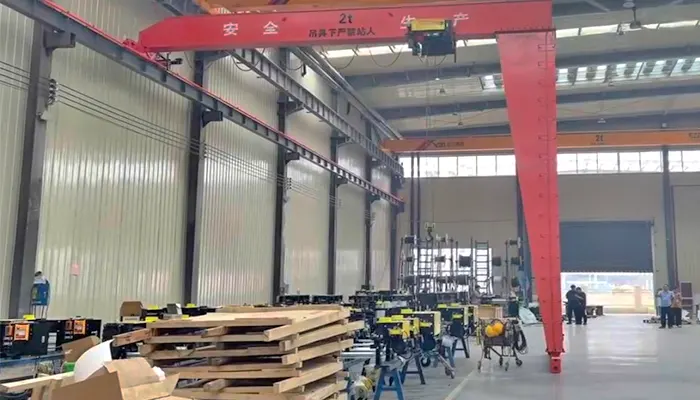
Rail-Mounted Semi Gantry Crane Systems
Trackless (Rail-Free) Semi Gantry Crane Systems
Scope of Comparison in Industrial Projects
Initial Capital Cost Breakdown (CAPEX Comparison)
Rail Installation System Costs
The workshop floor must be prepared to ensure stable rail foundation. This often includes concrete reinforcement, base leveling, and load-bearing adjustments.
Steel rails, fastening components, and alignment hardware are required. The alignment accuracy is critical because even small deviations can affect crane travel stability.
Skilled labor is needed for rail positioning, welding, and anchoring. This is not a simple assembly task; it requires measurement and adjustment work during installation.
Depending on crane capacity (for example 5 ton or 10 ton semi gantry crane systems), the ground structure may need reinforcement to distribute wheel loads evenly.
In many factories, part of the production area must be stopped during installation. This indirect cost is often overlooked but can be significant in active workshops.Trackless System Costs
The core investment is the crane body itself, including the gantry structure and ground wheel traveling mechanism designed for floor movement.
Instead of rail construction, the focus is on ensuring the workshop floor has sufficient load-bearing capacity and surface flatness.
In most cases, no embedded rail installation is required. Only basic adjustments or local reinforcement may be needed depending on site conditions.
Installation mainly involves mechanical assembly and positioning. It does not require long-term rail alignment work.
The system can often be put into operation in a shorter time, reducing waiting time before production starts.Practical Cost Insight for Buyers
Why Cost Structure Matters in Crane Selection
How is crane cost linked to mobility design?
What is the core difference between rail-mounted and trackless systems?
Rail-mounted semi gantry crane:
Trackless semi gantry crane:
Why is total cost of ownership (TCO) more important than purchase price?
Why does cost structure matter in industrial projects?
What is the simple cost decision logic?
Installation Time and Project Downtime Cost
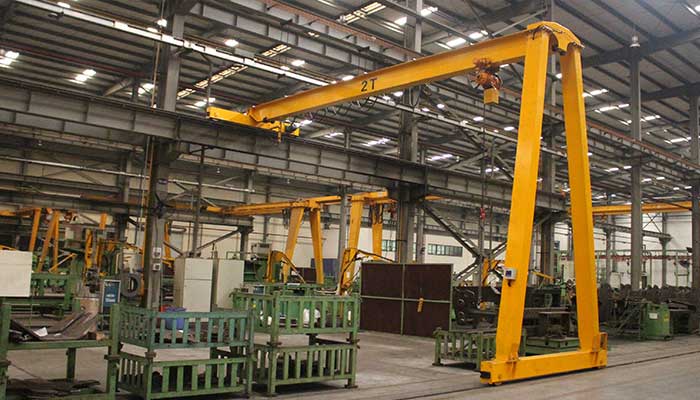
In practical workshops—steel fabrication plants, precast yards, or maintenance facilities—production cannot always stop for long periods. So the installation cycle becomes part of the cost structure, not just a technical step.Rail-Mounted Systems: Longer Installation and Higher Downtime Exposure
The workshop floor must be prepared first, often involving excavation, concrete reinforcement, and leveling work.
Rails are positioned, fixed, and anchored into the foundation. This step requires careful measurement and repeated adjustments.
Precision alignment is carried out to ensure smooth crane travel. Even small deviations can cause long-term operational issues.
Load testing and movement trials are completed before full operation begins.Trackless Systems: Shorter Installation and Faster Commissioning
Main structures, hoisting system, and wheel assemblies are delivered in pre-assembled or semi-assembled form.
Components are assembled on-site with minimal structural modification.
Functional checks and load testing are completed in a shorter cycle.Practical Cost Perspective in Industrial Projects
Maintenance and Lifecycle Cost
Rail System Maintenance Costs
Continuous operation causes rail surfaces to wear over time. Even small misalignments can affect crane running stability, so periodic correction is needed to maintain smooth movement.
In long-term industrial use, concrete foundations may experience slight settlement or deformation. This can lead to uneven rail levels and requires corrective engineering work.
Regular inspection is needed to ensure both rails remain aligned within tolerance. This often involves measurement tools, adjustment work, and sometimes partial reinstallation.
Because the system depends on permanent rail infrastructure, maintenance is not limited to crane parts. It extends to civil structure maintenance, which increases lifecycle workload.Trackless System Maintenance Costs
The crane runs directly on the workshop floor, so surface condition becomes important. Regular inspection helps prevent uneven wear or operational instability.
The wheel system carries all movement load. Over time, tires or rollers need replacement depending on usage frequency and load intensity.
Without rail infrastructure, there is no need for alignment correction or foundation adjustment. This reduces civil maintenance work significantly.
Maintenance is mainly concentrated on wheels, bearings, and travel mechanisms instead of workshop structures.Practical OPEX Comparison in Operations
Scalability and Future Expansion Costs
Rail System: Expansion Tied to Structural Work
Trackless System: Expansion Through Equipment Scaling
Practical Scalability Cost Perspective
Risk-Adjusted Cost Considerations
Rail Systems: Higher Upfront Investment Risk
Trackless Systems: Lower Sunk Cost Exposure
Practical Risk Perspective in Industrial Investment
Total Cost of Ownership (TCO) Comparison Summary
CAPEX: Initial Investment Structure
OPEX: Long-Term Operating Cost Structure
Flexibility Cost: Adaptation to Production Change
Lifecycle ROI: What ly Determines Long-Term Value
Practical Summary for Industrial Buyers
Application-Based Cost Decision Framework (Buyer Guide)
Choose Rail-Mounted Systems When Production Is Stable and Repetitive
Material moves along a stable path, such as cutting → welding → assembly → storage, without frequent layout changes.
In steel mills, heavy fabrication workshops, or precast production lines, cranes operate repeatedly on the same route, which benefits from rail-guided precision and stability.
Workshop design is already finalized, and future expansion or relocation is not expected in the near term.Choose Trackless Systems When Flexibility and Change Are Expected
Workstations, storage areas, or production zones are reorganized based on project demand or product type.
One crane may need to serve several working zones instead of following a single fixed route.
Projects that want to reduce civil construction cost or avoid rail installation often prefer trackless systems for faster deployment.Practical Buyer Interpretation of Cost Decision
Simple Field-Level Decision Logic
Final Practical Note for Industrial Projects
Conclusion: Cost Is Not Only Price — It Is Structural Commitment
Two Different Cost Strategies in Practice
The cost is concentrated at the beginning stage. It includes civil engineering, rail installation, alignment work, and long-term fixed layout planning. Once built, the system is stable and efficient in repetitive production environments, but it is closely tied to the original workshop structure.
The cost is distributed more toward equipment rather than infrastructure. The system relies on ground mobility instead of permanent rails, which reduces construction work and allows easier repositioning when production changes.How the Final Decision Is Actually Made
If the workflow is fixed, predictable, and designed for long cycles, rail systems tend to provide stable operational performance.
If the workshop layout may change, expand, or shift between projects, trackless systems reduce the cost of future adjustments.
Some projects prefer to invest more upfront into infrastructure stability, while others prefer to keep investment flexible and shift cost into equipment that can be reused or relocated.Final Practical Understanding

Article by Bella ,who has been in the hoist and crane field since 2016. Bella provides overhead crane & gantry crane consultation services for clients who need a customized overhead travelling crane solution.Contact her to get free consultation.
Yuantai Cranes
Overhead Crane Manufacturer with CE, ISO, SGS, CNEX Certificates.
- Main Specifications - Capacity: 0.5–550 tons | Span: up to 40m | Speed: 0.8–12 m/min | Duty: A3–A7 | Power: 380–690V, 50/60Hz | Control: pendant/remote/cabin
- Full engineering: FEA/PLC/VFD + in-house build + global delivery + on-site support, for workshops, factories, EPC contractors, industrial projects, etc.
- Support: design, manufacturing, testing, service – end-to-end, customized lifting solutions worldwide.
How to Get an Accurate Crane Price for Your Application?
Tips: Copy the spec list, fill in your details, and paste it into the form on the right/ down-below for a quick price.
- Crane type:_____ . (e.g., overhead crane, gantry crane, jib crane)
- Max weight to lift:_____ tons. (e.g., 2t, 5t, 10t, 20t, 50t)
- Lifting height:_____ m. (How high does the hook need to reach?
- Workshop width (span):_____ m . (Distance between the two crane rails)
- Travel distance:_____ m . (How long does the crane need to move along the runway?)
- Control type:_____. (Pendant / remote / cabin Control)
- Power supply:_____. (Local voltage & frequency – e.g., 380V, 50Hz, 3-phase)
- What will it be used for?_____ (e.g., steel fabrication, concrete products, mold handling, general manufacturing, etc.)
- Any special requirements?_____ (e.g., extreme temperature, dusty or explosive environment, special paint color, etc.)
Just leave a message via the contact form and our hoist and crane engineer will contact you with in 24working hours.
Get Your Custom Quote–Quick & Easy
Fill in what you know. Skip what you don't – we'll help.Any question will be reply with 24 working hours