Your Trusted Top Running Overhead Crane Manufacturer & Supplier
Top Running Hoist Crane 1 Ton to 320 Ton
Affordable Single & Double Girder Overhead Bridge Crane with
Hoist Trolley & Open Winch Trolley Top Running Crane Solutions
Save Your Space, Save Energy and Coffective Soliton
Single & Double Girder Overhead Bridge Crane
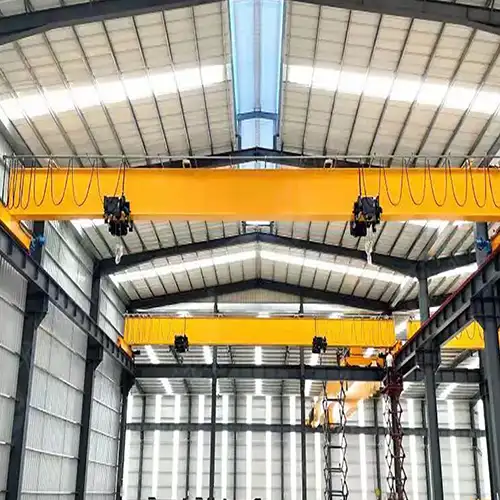
A top running hoist crane is a type of overhead bridge crane where the crane wheels travel on rails mounted on top of runway beams. The crane bridge spans across the workshop, and the hoist trolley moves along the girder to lift and move materials across the workspace. Because the crane sits above the runway beams, it can handle heavier loads and achieve greater lifting height compared with many suspended crane systems.
What Is a Top Running Hoist Crane?
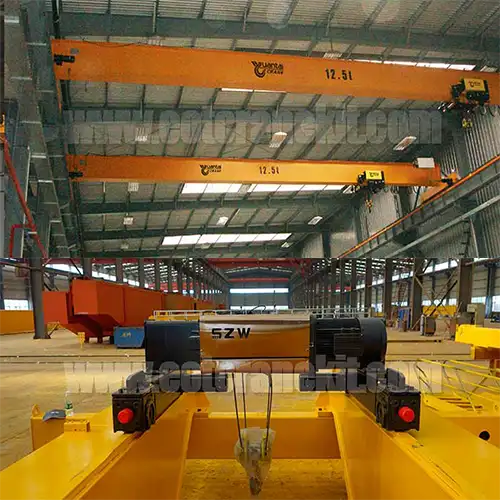
A top running hoist crane is an overhead crane system designed to travel on rails installed on top of runway beams. The crane bridge runs along these rails, while the hoist trolley moves sideways along the girder. Together, these movements allow operators to lift a load, move it across the workshop, and place it exactly where it is needed.
In everyday factory operations, this three-direction movement is what makes an overhead bridge crane so useful.
- Up and down through the hoist lifting mechanism
- Side to side as the trolley travels along the bridge girder
- Forward and backward as the crane bridge moves along runway rails
So yes, the crane can basically reach any point within the rectangular working area of the workshop. That's why many factories rely on it as the main material handling system.
How a Top Running Crane Moves on Runway Beams
The structure of a top running overhead crane system is relatively simple but very strong. The runway beams run along the length of the building and are supported by structural columns. On top of these beams, steel crane rails are installed. The crane wheels travel along these rails, carrying the bridge and hoist across the workshop.
Because the crane runs on top of the runway beams, the load is transferred directly to the building columns and foundations. This design allows the system to support larger loads and wider spans compared with suspended crane systems.
- runway beams with crane rails
- bridge girder or double girders
- end trucks with crane wheels
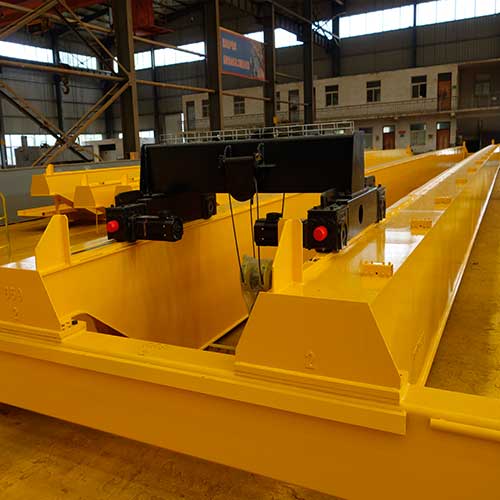
- electric hoist or wire rope hoist trolley
- electrical control system and power supply
In many industrial buildings, these cranes run the full length of the workshop bay. Operators can move materials from storage areas to production stations without using forklifts or floor transport equipment. It saves time, and honestly, it keeps the shop floor much clearer.
Top Running Crane vs Underhung Crane
When selecting an overhead bridge crane, many buyers compare top running cranes with underhung cranes (also called under-running cranes). The key difference lies in how the crane is supported by the building structure.
Top Running Overhead Crane
- crane wheels run on rails installed above runway beams
- suitable for heavy loads and larger capacities
- supports longer spans across wide workshops
- commonly used in manufacturing plants and steel processing facilities
Underhung Overhead Crane
- crane is suspended from the lower flange of a building beam
- typically used for lighter loads and smaller spans
- often installed in smaller workshops or workstation crane systems
Because the runway beams support the crane directly, a top running crane system can handle heavier lifting tasks and higher duty cycles. For many industrial plants, it is simply the more robust option.
When planning an overhead crane system, buyers often compare top running cranes and underhung cranes. Both are bridge cranes used for material handling inside buildings, but their structure and load capacity are quite different. The main difference lies in how the crane is supported by the building and where the crane wheels travel.
A top running overhead crane runs on rails installed on top of runway beams supported by building columns. This allows the crane to handle heavier loads and cover larger spans. An underhung crane, on the other hand, is suspended from the lower flange of a beam, which limits the load capacity but can work well in lighter workshops or facilities with lower lifting requirements.
Comparison of Top Running Crane and Underhung Crane
| Feature | Top Running Crane | Underhung Crane |
|---|---|---|
| Rail position | On top of runway beam | Under beam flange |
| Capacity | Up to 550 ton | Usually <10 ton |
| Span | Large span | Limited span |
| Hook height | Higher | Lower |
In practice, the choice usually depends on the lifting capacity required and the building structure available. Heavy manufacturing plants, steel processing workshops, and equipment assembly facilities typically install top running bridge cranes because they provide stronger support and higher lifting height. Smaller workshops or light-duty production lines may prefer underhung cranes, which are simpler and suitable for lighter loads.
Summary
- Top running cranes are better suited for heavy loads, larger spans, and higher lifting heights.
- Underhung cranes are commonly used in light-duty workshops where lifting capacity requirements are lower.
Why Many Factories Choose Top Running Hoist Cranes
In real production environments, equipment needs to be reliable and practical. That's one reason top running hoist cranes are widely used in heavy manufacturing. They provide strong lifting capacity while covering a large working area.
Another advantage is lifting height. Since the crane runs above the runway beams rather than below them, the hoist can travel higher, which gives more usable space under the hook.
Factories often choose this crane design for several practical reasons:
- Higher lifting height compared with underhung crane systems
- Larger load capacity, suitable for medium-duty and heavy-duty lifting
- Strong and stable structure designed for continuous industrial operation
- Large span coverage, allowing one crane to serve an entire workshop bay
For steel plants, machinery factories, fabrication shops, and power equipment workshops, a top running hoist crane often becomes the main lifting equipment running across the production floor. Once installed, it quietly does its job every day—lifting, moving, positioning heavy loads—keeping production moving without much fuss. Check more on Top Running Crane vs Underhung Cranes, which to Choose ?
Types of Top Running Hoist Cranes
Top running hoist cranes come in single girder and double girder designs, each suited to different lifting capacities, spans, and industrial applications.
Single Girder Top Running Crane
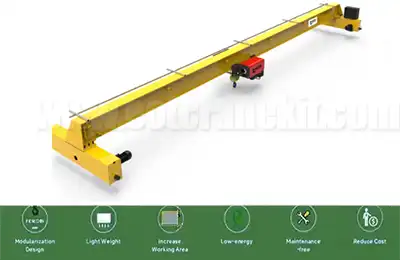
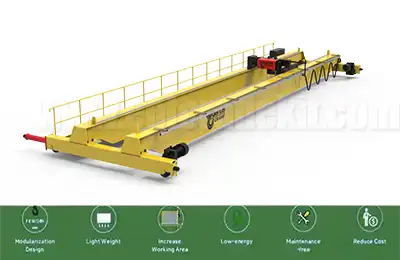
A overhead top running single girder crane is ideal for light to medium-duty lifting tasks. It uses an electric hoist trolley that travels along a single bridge girder, making it compact and cost-effective.
Typical specifications:
- Capacity: 1 – 20 ton
- Span: 7.5 – 28 m
Common applications: warehouse material handling, machine shops, light manufacturing plants
Advantages:
- lower equipment and installation cost
- simple and fast installation
- electric hoist trolley system for smooth lifting and travel
Common hoist options:
- Electric wire rope hoist trolley (standard): smooth lifting, suitable for 1–20 ton capacity
- CD/MD electric hoist: cost-effective for light and medium loads
- Low headroom hoist trolley: fits workshops with limited height
- Optional explosion-proof hoist: for hazardous environments
Key points for buyers:
- Single girder cranes mostly use compact hoists for efficiency.
- Ideal for warehouses, small workshops, and light manufacturing plants.
- Can be customized with low headroom or explosion-proof options if needed.
Double Girder Top Running Crane
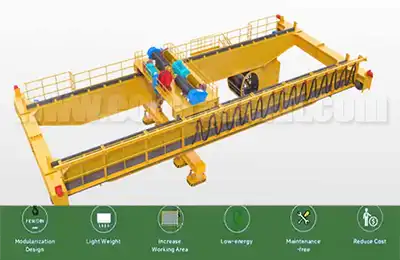
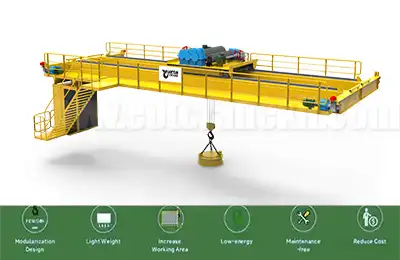
A top running double girder crane is designed for heavier loads, longer spans, and frequent operations. It provides higher lifting heights, greater stability, and the flexibility to use a variety of hoist and trolley systems.
Typical specifications:
- Capacity: 20 – 550 ton
Common applications: steel plants, heavy equipment manufacturing, power plants, foundries
Advantages:
- higher lifting height and larger load capacity
- suitable for heavy-duty industrial operations
- supports auxiliary hoists and multiple trolley options
Common hoist options:
- Electric wire rope hoist trolley: standard for medium loads
- Double girder crab hoist trolley: stable for heavier loads
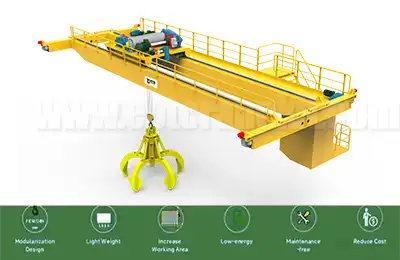
- Open winch trolley: heavy-duty lifting, up to 550 tons
- Low headroom hoist trolley: for workshops with limited ceiling height
- European-style open crab trolley / winch trolley: precision and smooth operation
- Optional explosion-proof hoist: for chemical or flammable environments
Key points for buyers:
- Double girder cranes allow larger lifting capacity and higher hook heights.
- Suitable for steel plants, heavy equipment manufacturing, power plants, and foundries.
- Can support auxiliary hoists or multiple hoists for complex operations.
Top Running Single Girder Hoist Crane
A top running single girder hoist crane uses one bridge girder with an electric wire rope hoist trolley traveling along the beam. The crane runs on rails mounted on top of runway beams, providing efficient overhead lifting for light to medium-duty material handling in workshops and warehouses.
Typical capacity: 1 ton – 20 ton
Common applications: warehouse material handling, machine workshops, fabrication shops, equipment maintenance areas
Key features
- simple and compact crane structure
- lower equipment and installation cost
- electric hoist trolley for smooth lifting and travel
- easy installation and maintenance
This type of single girder top running overhead crane is widely used in small and medium factories where lifting tasks are moderate and daily operations require a reliable, cost-effective crane system.
Top Running Double Girder Hoist Trolley Crane
A top running double girder hoist trolley crane uses two bridge girders with a trolley-mounted electric wire rope hoist traveling on rails installed above the girders. This design provides higher lifting height and better stability when handling heavier loads in industrial workshops.
Typical capacity: 3 ton – 80 ton
Common applications: machinery manufacturing plants, steel fabrication workshops, equipment assembly lines, industrial warehouses
Main advantages
- higher lifting height
- more stable lifting for larger loads
- suitable for frequent lifting operations
- stronger structure for medium to heavy-duty use
This type of double girder top running overhead crane is widely used in medium and heavy industrial environments where loads are larger and lifting operations occur regularly.
Top Running Double Girder Open Winch Trolley Crane
A top running double girder open winch trolley crane uses a heavy-duty open winch hoisting mechanism mounted on a trolley that travels on rails above the two bridge girders. This design is commonly used for very heavy lifting tasks where standard electric hoists are not sufficient.
Typical capacity: 5 ton – 320 ton, heavy-duty systems up to 550 ton
Typical industries: steel mills, foundries, heavy equipment manufacturing plants, power generation facilities
Key features
- very large lifting capacity
- heavy-duty open winch hoisting mechanism
- stable lifting for large industrial components
- suitable for continuous heavy-duty operation
These top running winch trolley overhead cranes are often installed in heavy industrial plants where cranes operate throughout the day, lifting large components such as steel slabs, heavy machinery parts, or power equipment. In these environments, the hoisting system must be strong, reliable, and built for long-term industrial use.
Technical Specifications of Top Running Hoist Cranes
When choosing a top running hoist crane, most buyers focus on a few practical numbers: lifting capacity, span, lifting height, and working duty. These specifications help determine whether the crane fits the workshop layout and the lifting tasks.
In real factory projects, the crane is often custom designed to match the building structure and the materials being handled. For example, a small maintenance shop may only need a 3-ton or 5-ton top running single girder crane, while a steel plant may install a 100-ton or 200-ton double girder overhead crane.
Below is a typical specification range for top running overhead bridge cranes used in industrial workshops.
Typical Technical Specifications Table
Typical Technical Specifications
| Parameter | Range |
|---|---|
| Capacity | 1 – 550 ton |
| Span | 7.5 – 35 m |
| Lifting height | 6 – 30 m |
| Work duty | A3 – A7 |
| Hoist type | electric wire rope hoist / open winch hoist |
| Control | pendant control / radio remote control / cabin control |
These values cover most industrial lifting applications, from light manufacturing workshops to heavy steel production plants.
Popular Capacity of Top Running Hoist Cranes
When searching for an overhead bridge crane, many buyers start by looking at the lifting capacity. Certain capacities appear more often because they match common industrial lifting needs.
Capacities such as 3 ton, 5 ton, 10 ton, 20 ton, and 50 ton top running cranes are widely used across different industries. They cover most workshop lifting tasks, from light equipment handling to medium and heavy industrial loads.
3 Ton Top Running Overhead Crane
- Equipment maintenance areas
- Small machine shops
- Repair workshops
Configured as a single girder top running crane with an electric wire rope hoist.
- Warehouse material lifting
- Machinery maintenance areas
- Fabrication shops
Common choice for good lifting capability without a large crane structure.
10 Ton Top Running Overhead Crane
- Machinery manufacturing workshops
- Steel fabrication plants
- Equipment assembly lines
Can be configured as single or double girder, depending on span and lifting height.
20 Ton Top Running Overhead Crane
- Mold handling in manufacturing plants
- Lifting heavy machine components
- Industrial assembly operations
Often configured as a double girder crane for stability and height.
50 Ton Top Running Overhead Crane
- Steel processing plants
- Heavy equipment manufacturing
- Power plant maintenance workshops
Typically double girder with hoist or winch trolley for heavy-duty lifting. More aboout our light duty overhead crane and heavy duty overhead crane capacity or contact us to get your tailored top running overhead bridge cranes for your industrial soltuions. WhatsApp; + 86 151 3871 1597.
Custom Options and Features
Every workshop has different lifting needs, and top running hoist cranes can be customized with optional features to make operations safer, smoother, and more efficient.
- Variable Frequency Drive (VFD): smooth acceleration/deceleration, precise positioning, energy-efficient.
- Anti-sway control: reduces load swing, especially for long/heavy loads.
- Radio remote control: operate the crane from a safe distance.
- Overload protection: prevents lifting beyond rated capacity.
- Anti-collision system: prevents collisions with structures, other cranes, or obstacles.
- Explosion-proof design: for hazardous environments.
These custom options ensure the crane is safe, reliable, and tailored to your workshop operations.
Your Trusted Top Running Overhead Crane Manufacturer & Supplier