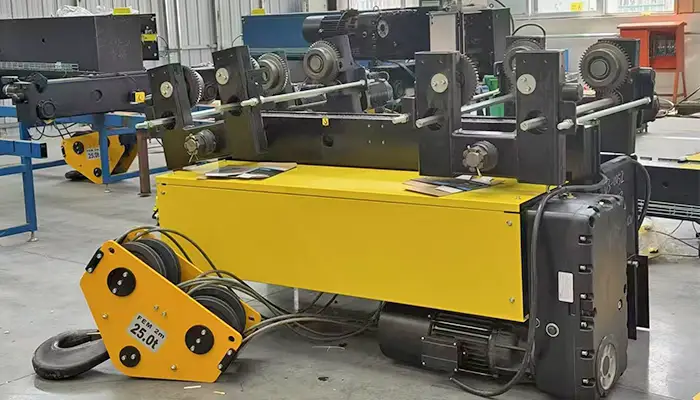
25 Ton Electric Hoist Protection System Design Guide
Content Quick Link
Electrical Protection Design in a 25 Ton Electric Hoisting System
(Applied to 25 Ton Electric Wire Rope Hoist / Low Headroom Hoist Crane / Electric Cable Hoist Systems)
Why Electrical Protection Matters in 25 Ton Electric Hoists
In a 25 ton electric hoist system, electrical protection is part of the core lifting logic. It is not an external safety accessory. When the hoist is lifting close to rated capacity, every electrical signal directly affects mechanical behavior. A 25 ton electric wire rope hoist does not operate in isolation. Power supply stability, motor response, and brake timing all interact at the same moment.
How is electrical protection built into a 25 ton electric hoist system?
In a 25 ton electric hoist system, electrical protection is part of the core lifting logic. It is not an external safety accessory. When the hoist is lifting close to rated capacity, every electrical signal directly affects mechanical behavior.
A 25 ton electric wire rope hoist does not operate in isolation. Power supply stability, motor response, and brake timing all interact at the same moment. If one part reacts incorrectly, the load does not wait. It moves, or it stops suddenly.
That is why protection design is treated as part of system engineering, not panel wiring only.
How do the main electrical components work together in a 25 ton hoist?
Hoisting motor
- Converts electrical energy into lifting force
- Monitored for overload and abnormal current behavior
- First point where electrical stress becomes visible
Brake system
- Holds load when power is removed
- Must engage immediately during fault conditions
- Timing between motor stop and brake action is critical in 25 ton lifting
Control panel / VFD system
- Manages speed, start, and stop commands
- Receives signals from safety devices
- Coordinates response sequence during faults
When these three are not synchronized, the hoist may still run, but stability under load becomes inconsistent.
What does fail-safe mean in real crane operation?
In European-style crane safety design, especially for 25 ton systems, the basic rule is simple: if something is wrong, the system stops. Not later. Not partially. It stops.
In practice, this means:
- Safety circuits are hardwired in series
- Emergency signals bypass normal control logic
- Power loss automatically triggers brake engagement
- Fault conditions block lifting instead of allowing reduced operation
This behavior is often tested during commissioning. When a phase loss is simulated, the hoist should stop immediately and require manual reset.
What is the practical takeaway for 25 ton electric hoist projects?
In real projects involving 25 ton electric wire rope hoists and crane systems, electrical protection should be treated as part of the lifting design itself.
- Do not separate mechanical capacity and electrical safety in evaluation
- Always check how overload, phase loss, and stop logic interact
- Confirm that brake action and motor stop are properly sequenced
- Test fault response before putting the crane into operation
In heavy lifting, stability is not only about steel structure. It is also about how fast and correctly the electrical system reacts when conditions change.
Overload Protection System in 25 Ton Electric Hoists
What is the role of overload protection in 25 ton electric hoist systems?
In a 25 ton electric wire rope hoist system, overload protection is directly linked to structural safety and service life. It is not only a warning function. It actively controls whether lifting is allowed or not.
During real lifting work, loads are rarely perfectly static. A 25 ton electric hoist often faces small but sharp load variations caused by hook alignment, material contact, or sudden release of binding force. These short spikes are exactly where overload protection becomes necessary.
The protection system is designed to safeguard key components:
- Wire rope drum system, where overload increases rope tension and fatigue
- Hook block assembly, which carries full lifting force in every cycle
- Gearbox and motor thermal system, which reacts to repeated overload events
In practice, this function is essential for both standard wire rope hoists and 25 ton low headroom hoist cranes, where space constraints often increase dynamic stress.
What overload detection methods are used in 25 ton systems?
Different technical methods are used to detect overload in industrial hoists. The selection depends on control system design and project requirements.
Load cell measurement (hook-based)
- Direct measurement of lifted weight
- High accuracy and stable output
- Common choice for 25 ton electric wire rope hoists in European-style crane systems
Motor current analysis (VFD-based detection)
- Estimates load through electrical current feedback
- Works continuously during operation
- Sensitive to acceleration and braking phases
Dual confirmation logic (load + current)
- Compares mechanical load and electrical signal
- Reduces false alarms during transient motion
- Preferred in heavy-duty or high-cycle applications
In real projects, dual logic is often used for 25 ton cable hoist systems where load variation is more frequent during long travel movement.
How is overload protection calibrated in 25 ton hoist systems?
Overload protection must be calibrated carefully. If it is too sensitive, the hoist will stop too often. If it is too loose, mechanical risk increases.
Rated load reference
- 25 ton defined as 100% working limit
- This is the normal operating boundary
Warning zone
- Usually set at 90–95% load
- Operator receives early notification
- No immediate stop, only signal feedback
Cut-off zone
- Typically 105–110% load
- Hoisting motion is stopped automatically
- Prevents further lifting force application
Special adjustment consideration (low headroom hoist crane)
- Compact geometry increases reaction sensitivity
- Calibration may require tighter filtering logic
How does overload protection respond during operation?
The overload system does not act in a single step. It follows a controlled response sequence.
Alarm stage
- Visual indicator and audible signal activated
- Operator is informed but lifting is still possible
Control restriction stage
- Upward lifting motion is blocked
- Downward movement remains available for safety
Emergency stop stage
- Triggered when load exceeds safety limit
- Hoisting motion stops immediately
Fail-safe behavior
- If sensor signal is lost or abnormal
- System defaults to stop condition
- Hoist cannot restart until fault is cleared
This logic is particularly important in 25 ton low headroom hoist cranes, where reduced clearance leaves less tolerance for overload-related shock loading.
What is the practical takeaway for real 25 ton hoist applications?
In actual industrial use, overload protection is not something operators adjust daily. It works silently during every lifting cycle. But its behavior defines how stable the crane feels under load.
For 25 ton electric hoists, wire rope hoist systems, and cable hoist configurations, the key point is consistent response:
- If overload detection is stable, lifting feels controlled
- If it is unstable, even a strong crane structure will feel unreliable during operation
Phase Sequence and Phase Loss Protection in 25 Ton Electric Hoists
Why does phase protection matter in a 25 ton electric hoist system?
In a 25 ton electric wire rope hoist, the motor operates under heavy mechanical load through a gearbox and brake system, often with frequent start-stop cycles. Because of this, phase stability is a basic requirement rather than an optional protection function.
When phase conditions are incorrect, the hoist does not simply "run differently". It can create direct mechanical risks such as:
- Reverse hoisting direction due to incorrect motor rotation
- Brake release timing mismatch before stable torque is established
- Gearbox shock loading during sudden direction or torque change
In 25 ton low headroom hoist cranes, the effect is more critical because the compact structure reduces mechanical buffer distance, transferring instability more directly into the crane system.
How does phase sequence protection work during power-on?
Phase sequence protection is mainly active during startup. It verifies whether the incoming three-phase power supply is in the correct order before enabling hoisting operation.
Typical logic in a 25 ton electric hoist system includes:
- Automatic detection at power-on stage
- Verification of correct phase order before motor enable
- Lockout of hoisting function if sequence is incorrect
If phase order is wrong, the system does not attempt partial operation. It blocks lifting completely. This applies to both standard 25 ton electric wire rope hoists and low headroom hoist crane systems.
How does phase loss protection work during operation?
Unlike phase sequence protection, phase loss protection operates continuously during running conditions. In a 25 ton electric cable hoist or wire rope hoist system, voltage instability can occur due to long cable runs, workshop fluctuations, or contactor wear.
The system continuously monitors all three phases. If abnormal conditions are detected, it reacts immediately.
Typical fault conditions include:
- Single-phase loss during lifting
- Severe voltage imbalance across phases
When this occurs, the system executes an immediate shutdown of hoisting motion. This protection is especially important for VFD-driven 25 ton electric hoists, where inverter stability depends on balanced input.
It directly protects:
- Motor windings from overheating or burnout
- VFD drive system from internal fault damage
What happens after a phase fault occurs (reset logic)?
After a phase-related fault occurs, the system does not restart automatically. This is a deliberate fail-safe design.
In a 25 ton electric wire rope hoist system, reset typically follows this sequence:
- Fault condition is cleared (phase restored and verified stable)
- Manual reset is required at control panel or pendant station
- System performs internal verification before enabling hoisting
- Only after confirmation is lifting operation reactivated
This prevents repeated fault cycling, which can otherwise introduce mechanical stress into the gearbox and brake system. During commissioning, engineers often simulate phase loss to verify that the system remains safely locked until manual reset is performed.
Emergency Stop (E-Stop) Circuit Design for 25 Ton Hoist Systems
What is the functional role of emergency stop in a 25 ton hoist system?
In a 25 ton electric hoist system, the emergency stop is the final and most direct safety action. It is designed to stop movement immediately when normal control is no longer appropriate.
When activated, it stops all motion in the system, including:
- Hoisting movement in 25 ton electric wire rope hoists
- Trolley travel in bridge crane or gantry crane systems
- Coordinated movement in low headroom hoist crane configurations
This function is not dependent on software decision-making. It is a direct safety interruption with the highest priority in the control system.
How is the emergency stop circuit structured in 25 ton hoist systems?
The emergency stop circuit in a 25 ton electric hoist is built on a fail-safe principle: if the safety loop is broken, the system must stop.
Typical structure includes:
- Hardwired safety loop using normally closed (NC) contacts
- Continuous circuit monitoring from all control points
- Immediate interruption of control power when loop opens
Multiple emergency stop points are typically installed for accessibility:
- Pendant control station for the operator
- Remote or wireless pendant system (if included)
- Crane bridge or ground-level stop station for maintenance personnel
This circuit integrates with:
- Safety relay or safety PLC system
- Contactor coil control circuit
- VFD enable signal in variable-speed or low headroom systems
In 25 ton electric wire rope hoists, this ensures no single control device can bypass the stop function.
How does emergency stop behave during real operation?
Emergency stop response depends on whether the system uses direct contactor control or VFD control.
Category 0 stop
- Immediate power cut to motor
- Brake engages instantly
- Used in standard safety circuits for 25 ton hoists
Category 1 stop
- Controlled deceleration before stopping
- Common in VFD-based systems and low headroom hoist cranes
- Reduces mechanical shock during stopping
In many 25 ton electric hoist systems, both behaviors may be used depending on fault severity. The key requirement is predictable and safe stopping behavior under all conditions.
What is the restart logic after emergency stop activation?
After an emergency stop is activated, the system does not restart automatically. This is a mandatory safety requirement in all 25 ton electric hoist systems.
The restart sequence typically includes:
- Manual reset at control panel or pendant station
- Verification that all emergency stop points are released
- Safety circuit integrity check before re-energizing power
- Enablement of hoisting operation only after confirmation
No automatic restart is permitted under any condition.
In real workshop environments, this prevents unexpected movement after fault clearance or power restoration, especially in 25 ton wire rope hoists where suspended loads carry significant stored energy.
Integrated Protection Logic Architecture in 25 Ton Hoist Systems
In a 25 ton electric hoist system, protection functions are not independent modules. They are arranged in a layered logic structure so that the system always reacts in the correct priority order during real operation of a 25 ton electric wire rope hoist.
Why is protection in a 25 ton electric hoist considered a layered system?
In a 25 ton electric hoist system, multiple signals such as overload, phase fault, emergency stop, and operator commands may occur at the same time. The system does not treat them equally. Instead, it follows a strict priority structure to ensure predictable behavior under load.
This is critical in real lifting conditions where load behavior can change quickly. The control system must always decide which signal has authority to prevent unsafe movement.
What is the protection priority hierarchy in a 25 ton hoist system?
The control logic in a 25 ton hoist system follows a fixed safety priority order:
Emergency stop (highest priority)
- Immediately overrides all other signals
- Stops hoisting motion without delay
- Applies to wire rope hoists and low headroom hoist crane systems
Overload protection
- Blocks lifting when load exceeds safe limit
- Prevents continued upward motion under unsafe conditions
Phase loss / phase sequence protection
- Stops system during unsafe power conditions
- Protects motor and VFD from electrical damage
Normal operation commands (lowest priority)
- Start, stop, and speed control signals
- Only active when all safety conditions are normal
How do different system components coordinate safety in a 25 ton hoist?
In a 25 ton electric wire rope hoist or cable hoist system, safety is distributed across multiple hardware layers:
Control cabinet (PLC or relay logic)
- Processes overload, phase, and emergency signals
- Controls system enable/disable logic
- Ensures correct sequence before lifting
VFD drive system (where applicable)
- Controls motor speed and acceleration
- Stops output immediately when safety input is triggered
- Common in low headroom hoist crane systems
Brake system
- Physically holds load when power is removed
- Engages automatically during fault or stop conditions
- Ensures fail-safe load holding
These systems must work together. If one responds but others do not, stability of the 25 ton electric hoist system is compromised.
What is the fail-safe principle in a 25 ton hoisting system?
The core principle in a 25 ton hoisting system is that no single failure should result in uncontrolled movement.
To ensure this, the system is designed so that:
- Any safety signal can independently stop the hoist
- Power loss automatically engages the brake
- Control signals cannot override safety inputs
- Wiring failure defaults to a stop condition
This is especially important in heavy-duty 25 ton electric wire rope hoists, where suspended load energy is high and safe stopping behavior is critical under all conditions.
European-Style Safety Compliance Considerations for 25 Ton Hoist Systems
Safety design aligned with European crane standards
Safety design aligned with European crane standards
In a 25 ton electric hoist system, safety design is not only based on internal engineering practice. It is also aligned with established European crane safety principles that define how electrical and functional safety should behave under fault conditions.
For 25 ton electric wire rope hoists, low headroom hoist cranes, and electric cable hoist systems, the key reference standards commonly include:
- EN 60204-32 – Electrical equipment of cranes
Focuses on wiring safety, control circuits, and electrical protection behavior in crane systems - EN 14492-2 – Power-driven hoists safety requirements
Defines functional safety expectations for hoisting, braking, and load control systems
These standards do not only describe design structure. They also define expected behavior during faults, which is critical in real lifting operation.
Core safety expectations in 25 ton hoist electrical design
Core safety expectations in 25 ton hoist electrical design
For compliance-oriented 25 ton hoist systems, certain design principles are consistently required in practical engineering projects:
Fail-safe design principle
- System must default to a safe condition when any fault occurs
- Loss of signal or power should not result in uncontrolled movement
- In most cases, safe state means stopping hoisting and engaging brake
Hardwired emergency stop chain
- Emergency stop must be physically wired in series
- It cannot rely only on PLC logic or software commands
- This ensures immediate response even if control system fails
Redundant fault detection
- Critical protections such as overload and phase loss should not rely on a single signal source
- Dual verification or layered detection is often used in 25 ton electric wire rope hoists
- Redundancy reduces risk of false operation or missed fault detection
These principles are especially important in low headroom hoist crane systems, where mechanical clearance is limited and reaction time is shorter.
Factory Acceptance Test (FAT) focus for 25 ton hoists
Factory Acceptance Test (FAT) focus for 25 ton hoists
Before a 25 ton electric hoist system is shipped, Factory Acceptance Testing is used to confirm that safety logic works under controlled conditions. This is not only a performance check. It is a functional safety verification process.
Key FAT checks typically include:
Overload simulation test
- System response is checked near and above rated load condition
- Verification of alarm, cut-off, and stop behavior
Phase loss simulation test
- One phase is intentionally disconnected in test condition
- Hoist must stop immediately and enter fault state
- Restart should only be possible after manual reset
Emergency stop response verification
- All E-stop points are activated one by one
- System must stop all movement instantly
- Brake engagement and power isolation are checked
In real 25 ton electric wire rope hoist projects, these tests are often witnessed by buyers or third-party inspectors. The goal is simple: confirm that safety functions behave correctly before installation on site.
Practical meaning for industrial hoist projects
Practical meaning for industrial hoist projects
In actual industrial use, compliance is not only about documentation. It is reflected in how the 25 ton hoist system behaves during unexpected conditions.
A properly designed system should always:
- Stop safely when electrical or control faults occur
- Prevent restart until faults are cleared and verified
- Maintain stable braking even during power loss
- React consistently across all control stations
For 25 ton electric hoists, especially in steel workshops, fabrication plants, and heavy handling lines, these safety behaviors directly affect operational reliability. It is not about formality. It is about how the crane behaves when something does not go as planned.
Common Engineering Risks in 25 Ton Electric Hoist Protection Design
Overload threshold set too high in 25 ton wire rope hoists
Overload threshold set too high in 25 ton wire rope hoists
In a 25 ton electric wire rope hoist system, overload protection must be aligned with real structural limits, not only nominal rating. One common issue in engineering practice is setting the overload cut-off too high.
When this happens, the system may still allow lifting beyond safe mechanical stress. It does not fail immediately, but repeated operation under this condition gradually affects:
- Wire rope fatigue and elongation
- Drum groove wear and uneven rope winding
- Hook block stress concentration
- Gearbox load accumulation over repeated cycles
This risk is more visible in 25 ton low headroom hoist cranes, where compact design reduces mechanical tolerance and increases load sensitivity.
Relying only on motor current detection
Relying only on motor current detection
Motor current-based overload detection is widely used in 25 ton electric hoist systems, especially with VFD control. However, relying on this method alone can lead to inaccurate interpretation of real load conditions.
The issue comes from the fact that motor current is not purely load-based. It is also affected by:
- Acceleration and deceleration phases
- Brake release timing
- Friction changes in gearbox and drum system
In real operation, this can cause two types of problems:
- False overload alarm during normal lifting start
- Missed overload condition during steady lifting with uneven load distribution
That is why current-based detection alone is not considered sufficient for heavy-duty 25 ton electric wire rope hoists.
Missing phase loss protection in VFD-based hoists
Missing phase loss protection in VFD-based hoists
In some 25 ton electric hoist systems, especially those using VFD drives, phase loss protection is assumed to be handled internally by the inverter. This assumption is not always safe in practical engineering design.
If phase loss protection is not independently configured:
- Motor may continue running under unbalanced supply
- VFD may enter unstable operation mode
- Internal overheating can occur in motor windings
This risk is more critical in electric cable hoist systems, where long power supply paths increase the chance of voltage imbalance or phase instability.
Emergency stop designed only in software logic
Emergency stop designed only in software logic
A serious design issue in some crane systems is implementing emergency stop through software control only. In a 25 ton electric hoist system, this approach is not reliable under fault conditions.
If emergency stop depends only on PLC logic or communication signals:
- Control system failure can disable stop function
- Communication delay may affect response time
- Fault in controller may prevent shutdown entirely
In proper 25 ton wire rope hoist design, emergency stop must be hardwired, directly interrupting control power or VFD enable signals, ensuring immediate action regardless of software condition.
Insufficient wiring redundancy in multi-station crane systems
Insufficient wiring redundancy in multi-station crane systems
In 25 ton hoist systems with multiple control points, such as pendant control, remote control, and ground station operation, wiring design plays a key role in safety reliability.
If redundancy is not properly designed:
- A single broken wire can disable safety chain
- Fault in one station may affect entire system operation
- Emergency stop coverage may become incomplete
This issue is more common in low headroom hoist crane installations, where compact control routing increases wiring complexity.
Proper design requires each station to independently maintain safety circuit integrity without affecting others.
Practical takeaway for 25 ton hoist engineering
Practical takeaway for 25 ton hoist engineering
In real 25 ton electric wire rope hoist projects, most safety issues do not come from mechanical failure. They come from incomplete or simplified electrical protection design.
A stable system is usually defined by three conditions:
- Correct overload detection method combination
- Independent and reliable phase protection
- Hardwired and redundant emergency stop circuit
When these three are properly designed, the hoist behaves predictably even under unstable working conditions.
Engineering Recommendation for 25 Ton Hoist Buyers and Designers
In a 25 ton hoist system, safety performance is not defined by a single device. It is defined by how overload, phase protection, and emergency stop work together as one system.
Overload protection based on real load measurement
Overload protection should be based on real load measurement
For a 25 ton electric wire rope hoist, overload protection should not rely only on estimation methods. In real lifting work, load conditions change quickly, and indirect signals can drift.
For this reason, the preferred solution is:
- Use load cell-based overload protection as the primary method
- Install measurement at the hook block where force is directly transmitted
- Ensure signal is stable during both lifting and lowering cycles
Motor current can still be used, but mainly as a secondary reference. In practical industrial use, direct load measurement gives more consistent behavior, especially in repetitive lifting operations.
Phase protection requirements
Phase protection must include both sequence and loss detection
In 25 ton electric hoist systems, phase-related faults can lead to unstable motor behavior if not handled properly. One protection function is not enough.
A complete design should always include:
Phase sequence protection
- Prevents incorrect rotation direction during startup
- Blocks hoisting operation before motor engagement
Phase loss detection
- Monitors real-time supply condition during operation
- Stops hoist immediately when imbalance or missing phase occurs
When both functions are used together, the system can handle both startup errors and operating faults. This is especially important for low headroom hoist cranes, where motor load changes faster due to compact structure and reduced mechanical buffering.
Emergency stop design requirement
Emergency stop must be hardwired and independent
For any 25 ton electric hoist system, emergency stop is not a control feature. It is a safety circuit requirement.
A proper design must ensure:
- Hardwired safety loop using normally closed contacts
- Multiple access points for emergency stop activation
- Independent circuit from PLC or software control logic
This means even if the controller fails, the system can still stop immediately.
In 25 ton wire rope hoists, this is especially important because suspended loads cannot be controlled manually once motion begins. The safety circuit must act directly on contactor or VFD enable signal without delay.
Low headroom stopping behavior
Low headroom hoist crane systems need controlled stopping behavior
In 25 ton low headroom hoist crane applications, structure height is limited, and mechanical clearance is smaller. This changes how stopping should be handled.
Instead of abrupt stopping, the recommended approach is:
Use VFD-based controlled deceleration
- Reduces sudden torque change in gearbox
- Protects beam structure from impact stress
Maintain stable braking sequence
- Motor slows first
- Brake engages after speed reduction
- Final stop occurs without mechanical shock
This type of control is not about comfort. It is about reducing long-term stress on crane structure and drive components.
Factory acceptance testing requirements
Full protection chain testing must be part of FAT
For 25 ton electric wire rope hoists and cable hoist systems, safety cannot be confirmed by design documents alone. It must be verified through testing before shipment.
Factory Acceptance Test (FAT) should always include:
- Overload protection verification under controlled load conditions
- Phase sequence and phase loss simulation testing
- Emergency stop activation from all control points
- Brake response and holding performance check after shutdown
In real projects, this step is often where design quality becomes visible. A system that passes FAT properly is more likely to behave consistently during site installation and long-term operation.
Practical closing note for buyers and engineers
Practical closing note for buyers and engineers
In 25 ton hoist projects, safety performance is not defined by a single device. It is defined by how overload, phase protection, and emergency stop work together as one system.
When these protections are correctly selected and tested, the hoist does not just lift load. It behaves in a controlled and predictable way under real industrial conditions.

Article by Bella ,who has been in the hoist and crane field since 2016. Bella provides overhead crane & gantry crane consultation services for clients who need a customized overhead travelling crane solution.Contact her to get free consultation.
Yuantai Cranes
Overhead Crane Manufacturer with CE, ISO, SGS, CNEX Certificates.
- Main Specifications - Capacity: 0.5–550 tons | Span: up to 40m | Speed: 0.8–12 m/min | Duty: A3–A7 | Power: 380–690V, 50/60Hz | Control: pendant/remote/cabin
- Full engineering: FEA/PLC/VFD + in-house build + global delivery + on-site support, for workshops, factories, EPC contractors, industrial projects, etc.
- Support: design, manufacturing, testing, service – end-to-end, customized lifting solutions worldwide.
How to Get an Accurate Crane Price for Your Application?
Tips: Copy the spec list, fill in your details, and paste it into the form on the right/ down-below for a quick price.
- Crane type:_____ . (e.g., overhead crane, gantry crane, jib crane)
- Max weight to lift:_____ tons. (e.g., 2t, 5t, 10t, 20t, 50t)
- Lifting height:_____ m. (How high does the hook need to reach?
- Workshop width (span):_____ m . (Distance between the two crane rails)
- Travel distance:_____ m . (How long does the crane need to move along the runway?)
- Control type:_____. (Pendant / remote / cabin Control)
- Power supply:_____. (Local voltage & frequency – e.g., 380V, 50Hz, 3-phase)
- What will it be used for?_____ (e.g., steel fabrication, concrete products, mold handling, general manufacturing, etc.)
- Any special requirements?_____ (e.g., extreme temperature, dusty or explosive environment, special paint color, etc.)
Just leave a message via the contact form and our hoist and crane engineer will contact you with in 24working hours.
Get Your Custom Quote–Quick & Easy
Fill in what you know. Skip what you don't – we'll help.Any question will be reply with 24 working hours