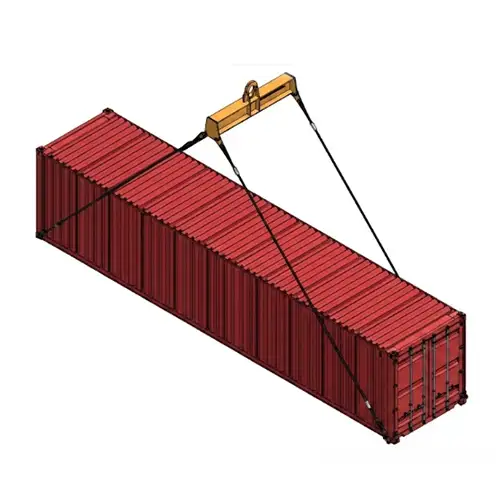
Container Lifting Beam for 20ft & 40ft Containers
Container lifting beam for 20ft and 40ft containers. A light-duty solution for warehouses, workshops, construction sites, logistics yards and occasional lifting.
| Crane Type | Fixed container lifting beam for 20ft and 40ft containers; designed for crane, gantry crane, mobile crane, or other suitable lifting equipment; customized twist-lock arrangement, beam length, lifting points, and capacity available. |
| Crane Capacity | Typically 5–50 ton+; selected according to maximum gross container weight, lifting beam self-weight, rigging, lifting configuration, and applicable load requirements. |
| Coverage Area Type | Container yards, loading and unloading areas, warehouses, truck loading zones, construction sites, freight yards, and designated container handling areas. |
| Application | 20ft and 40ft container lifting, loading and unloading, truck-to-yard transfer, warehouse handling, construction-site logistics, freight yards, shipping operations, and occasional container handling. |
| Certifications | CE / ISO / SGS / Other third-party inspection |
| Customization | Container: 20ft / 40ft / 20ft + 40ft;Connection: Twist Locks / Lifting Shackles / Hook Connections; Lifting Points: 4-Point / Multi-Point; Control: Manual / Semi-Automatic; Options: Container Corner Locks / Lifting Chains / Shackles / Load Monitoring / C |
Crane Manufacturer: Yuantai Cranes – 30+ Years Professional Crane Manufacturer from China
Category: Below Hook Devices
Tags: containercrane
Your Trusted Container Lifting Beam Manufacturer & Supplier
Container Lifting Beam | 5–32 Ton Fixed Spreader
Fixed Container Lifting Beam with Chain Slings for Occasional 20ft and 40ft Container Handling
Economical fixed container lifting beam with chain slings for occasional 20ft and 40ft container handling. Yuantai Cranes can customize the beam capacity, length, lifting points and rigging to match your container and existing crane. Light-duty container handling, warehouses, workshops, construction sites, small logistics yards and occasional container lifting.
Quick Answer: What Is the Most Economical Way to Lift a Container?
If you only handle containers occasionally, you may not need a motorized or telescopic container spreader.A fixed spreader beam with chain slings is often the simpler and more economical arrangement:
Crane Hook → Fixed Spreader Beam → Shackles → Chain Slings → Container
The correct design still depends on the container's maximum gross weight, crane capacity, lifting points, beam WLL, chain WLL, shackles and actual lifting configuration.
What Is a Light-Duty Container Lifting Beam?
A light-duty container lifting beam is a fixed-length steel spreader beam used with chain slings and shackles to lift containers from a suitable crane.
Unlike a telescopic container spreader, the beam has no hydraulic adjustment, electric drive or powered twist-lock mechanism.
This makes it a practical option when:
- Containers are lifted occasionally
- The same container size is handled repeatedly
- A suitable overhead or gantry crane is already available
- Manual rigging is acceptable
- Fast automated container engagement is not required
- Low purchase and maintenance cost is important
Yuantai Cranes can configure the beam around the customer's actual container, crane hook and lifting arrangement.
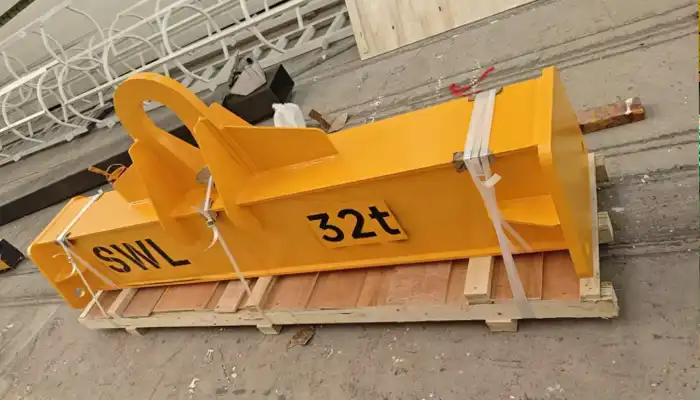
fixed length container lifting beam 32 ton for your reference
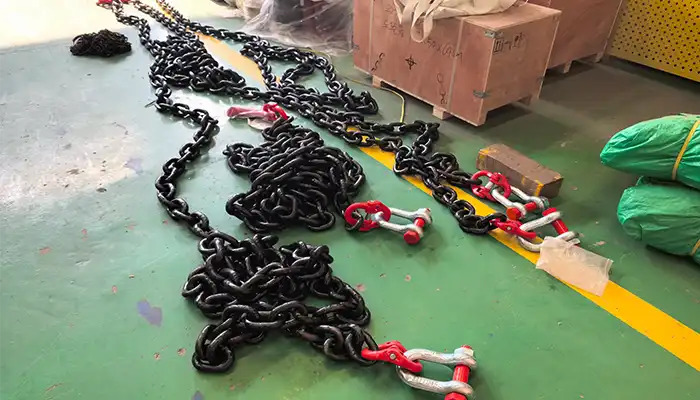
Lifting chan of the container lifting beam
Typical Technical Specifications
The following figures are typical starting points for an economical fixed container lifting beam. Final dimensions and ratings should be confirmed by engineering review.
| Parameter | Typical Specification |
|---|---|
| Product | Fixed Container Lifting Beam / Spreader Beam |
| Application | 20ft and 40ft container handling |
| Typical WLL | 5–32 ton |
| Customized Capacity | Available; higher capacities such as 32 ton can be designed |
| Beam Type | Fixed spreader beam |
| Beam Length | Customized according to lifting-point arrangement |
| Lifting Method | Top lift or bottom lift, application dependent |
| Rigging | 4-leg chain sling arrangement, where suitable |
| Chain | Grade 80 alloy steel chain or specified grade |
| Shackles | Alloy steel, WLL selected for the actual configuration |
| Upper Connection | Crane hook / lifting lug / customized connection |
| Lower Connection | Chain sling and suitable container connection |
| Adjustment | Fixed |
| Telescopic Mechanism | Not required |
| Hydraulic System | Not required |
| Electrical System | Not required |
| WLL / SWL Marking | Clearly marked |
| Identification Plate | Provided |
| Load Testing | According to project requirements |
| Documentation | Drawings, certificates, test records and manual as required |
Note: Capacity, beam dimensions and chain configuration are not determined by container length alone. The final design must be based on the maximum gross container weight and complete lifting arrangement.
Why Is a Fixed Container Lifting Beam More Economical?
The main reason is simple: a fixed beam does less, so it costs less. It is designed for a specific lifting arrangement and does not need the telescopic, hydraulic, or electrical systems found on more advanced container spreaders.
For customers who lift containers occasionally, this simpler design can provide the required lifting function without paying for features they may rarely use.
| Feature | Fixed Container Lifting Beam | Cost / Practical Benefit |
|---|---|---|
| Telescopic mechanism | Fixed-length beam with no telescopic adjustment | Lower manufacturing cost |
| Hydraulic system | No cylinders, pumps, or hydraulic controls | Fewer components to maintain |
| Electrical system | No motor, control cabinet, wiring, or remote control | Lower installation and maintenance cost |
| Moving parts | Simple structure with few moving components | Easier inspection and servicing |
| Chain & shackle rigging | Simple mechanical connections | Easy to inspect and replace |
| Maintenance | Mainly beam, chains, shackles, and hooks | Lower maintenance requirements |
| Initial investment | Simple fixed structure | Lower purchase cost |
| Operation | Manual rigging is normally required | Practical for occasional handling |
The cost advantage comes mainly from simplicity. There is no telescopic adjustment to manufacture, no hydraulic power unit to maintain, and no electrical control system to troubleshoot. For a warehouse or workshop that may only lift a container from time to time, that can make a significant difference to the overall equipment budget.
Fixed Beam vs. Telescopic Container Spreader
The two solutions are designed for different operating needs. A fixed beam focuses on simple and economical lifting, while a telescopic spreader adds flexibility and faster container engagement.
The right choice depends less on the container itself and more on how often you handle containers and how much flexibility you need.
| Consideration | Fixed Beam + Chains | Telescopic Container Spreader |
|---|---|---|
| Purchase cost | Lower | Higher |
| Design | Simple | More complex |
| Container sizes | Usually designed for a specific arrangement | Can accommodate different sizes |
| Hydraulic system | Not required | May be required |
| Electrical controls | Not required | May be included |
| Moving parts | Few | More |
| Maintenance | Relatively simple | More involved |
| Manual connection | Required | Reduced with dedicated systems |
| Occasional lifting | Good choice | May be unnecessary |
| Frequent container handling | Less convenient | Better choice |
| Automatic engagement | No | Available on suitable models |
| High-cycle operation | Not the primary application | Better suited |
In practical terms, there is no reason to buy a sophisticated telescopic spreader simply because it offers more functions. If the job is simple, the lifting equipment can often be simple too.
On the other hand, if operators handle 20ft and 40ft containers throughout the day, manual rigging can quickly become inconvenient. In that situation, the additional cost of a dedicated or telescopic spreader may be justified by faster and more repeatable operation.
Which Option Makes Sense for Your Operation?
A simple way to make the decision is to look at your actual working conditions rather than choosing equipment based only on the lowest price.
| Your Situation | Recommended Option |
|---|---|
| Occasional container lifting | Fixed beam + chains |
| Mainly one container size | Fixed beam + chains |
| Limited equipment budget | Fixed beam + chains |
| Existing overhead or gantry crane | Fixed beam + chains |
| Frequent 20ft/40ft container handling | Telescopic spreader |
| Need fast connection and release | Dedicated/telescopic spreader |
| Need powered operation | Telescopic spreader |
| High-cycle container handling | Dedicated container spreader |
For occasional lifting, the fixed beam + chain sling arrangement is often the more economical starting point. For high-frequency container handling, the extra flexibility and faster operation of a dedicated spreader can justify the higher investment.
In short: choose the simplest lifting system that properly matches the load, container, crane, lifting points, and working frequency.
How Does the Container Lifting System Work?
The complete lifting arrangement is:
Crane → Crane Hook → Spreader Beam → Shackles → Chain Slings → Container
Each component carries part of the lifting load.
The complete engineering check should consider:
- Container gross weight
- Crane capacity
- Crane hook capacity
- Spreader beam WLL
- Chain sling WLL
- Shackle WLL
- Sling angle
- Lifting-point arrangement
- Container structural condition
- Dynamic operating effects
Why Does Sling Angle Matter?When chain slings move away from the vertical, the tension in each sling leg increases.
For a simplified symmetrical arrangement:
T = W / (n × cos θ)
where:
- T = tension in each sling leg
- W = supported load
- n = effective number of sling legs
- θ = sling angle from vertical
Therefore, chain selection should not be based only on chain diameter or the nominal container weight.
Is a Fixed Beam Suitable for a 40ft Container?
It can be, provided the complete lifting system is properly designed and rated for the actual container and operating conditions.
The beam length should match the required lifting-point geometry, and the chain and shackle arrangement must be compatible with the container's approved lifting points or connection method.
For a 40ft container, provide Yuantai with:
Container gross weight + crane information + hook dimensions + lifting configuration
The engineering team can then determine the appropriate beam and rigging arrangement.
Top Lift or Bottom Lift?
The economical fixed beam can be configured for different lifting arrangements, depending on the container and application.
Top Lift
The rigging connects to the upper container connection points or suitable corner fittings.
Bottom Lift
The rigging connects to designated lower lifting points.
These are different load paths and should not be treated as interchangeable without checking the container and lifting arrangement.
What About Chain Slings and Shackles?
Yuantai can supply the fixed spreader beam together with compatible chain slings and shackles.
Chain Sling
Typical specifications include:
- Grade
- Diameter
- Length
- Number of legs
- Hook type
- WLL
- Connection configuration
Shackles
Check:
- WLL
- Pin diameter
- Body dimensions
- Connection compatibility
- Loading direction
- Correct assembly
The beam WLL, chain WLL, shackle WLL and crane capacity are separate ratings. The lowest-rated or otherwise governing component can determine the limitation of the complete arrangement.
When Is This Economical Beam NOT the Right Choice?
A fixed beam with chains is not the best solution for every container operation.
Consider a dedicated telescopic spreader when you need:
- Frequent container loading and unloading
- High-cycle operation
- Rapid connection and release
- Regular handling of both 20ft and 40ft containers
- Powered or semi-automatic container engagement
- More standardized container-terminal operations
For occasional lifting, however, paying for mechanisms you rarely use may not make economic sense.
Inspection Before Lifting
Before each lifting operation, the responsible lifting team should inspect the equipment according to the applicable procedures and requirements.
Crane
- Rated capacity
- Hook condition
- Hook latch
- Hoist condition
- Brake operation
- Limit devices
Spreader Beam
- WLL marking
- Identification plate
- Beam deformation
- Weld condition
- Lifting lugs
- Pins and holes
Chain Slings
- Chain condition
- Wear and elongation
- Cracks or damage
- Corrosion
- Hook condition
- WLL identification
Shackles
- Shackle body
- Pin condition
- WLL marking
- Correct assembly
Container
- Gross weight
- Lifting points
- Corner fittings
- Visible structural condition
Do Not Lift If:
- A load-bearing component is damaged
- Any component is incorrectly assembled
- The WLL or rated capacity is uncertain
- The lifting points or corner fittings are damaged
What Information Does Yuantai Need for a Quote?
You do not need to prepare a complete engineering drawing before contacting us.
Start with these basic details:
| Information | Example |
|---|---|
| Container size | 20ft / 40ft |
| Maximum gross weight | ___ ton |
| Cargo weight | ___ ton |
| Crane type | Overhead / Gantry / Mobile |
| Crane capacity | ___ ton |
| Hook dimensions | ___ |
| Required beam capacity | ___ ton |
| Beam length | ___ m |
| Lifting method | Top / Bottom |
| Chain slings | Required / Not required |
| Shackles | Required / Not required |
| Quantity | ___ set |
| Certification | Required standards |
| Project location | ___ |
A photograph of the crane hook, container lifting points or existing lifting arrangement can also help the engineering team understand the application.
Mozambique Project Example: 32 Ton Container Spreader Beam
A recent Yuantai requirement illustrates how this type of project starts.
Project: Mozambique
Date: July 28, 2026
Application: 40ft container handling
Beam capacity: 32 ton
Approximate beam length: 2.5 m
Chain slings: Included
Quantity: 1 set
The project demonstrates an important point:
The customer did not simply need "a 32-ton steel beam."
The beam, chains, shackles, crane connection and container lifting arrangement had to be considered together.
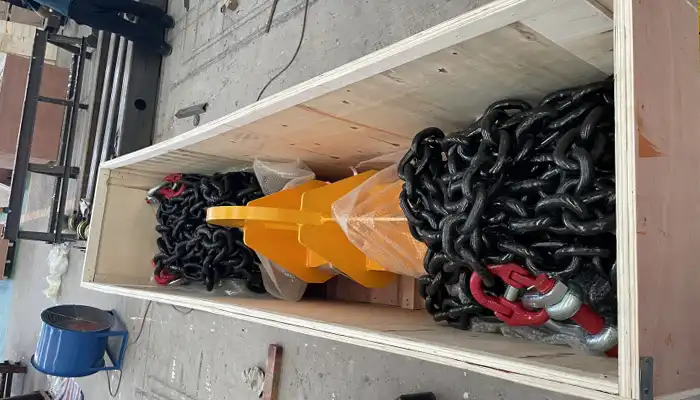
FAQ: Light-Duty Container Lifting Beam
Can I use a fixed beam to lift a 40ft container?
Yes, a fixed beam can be suitable for 40ft container lifting when the beam, chain slings, shackles, crane and container lifting points are all correctly matched to the actual load and lifting configuration. The beam should be designed around the required lifting-point geometry. A fixed arrangement is particularly practical for occasional handling where telescopic adjustment is not required.
Is a 5-ton beam enough for a container?
Only if the complete suspended load and lifting configuration are within the applicable ratings. Container size alone does not determine the required capacity. Check the maximum gross container weight, lifting accessories and crane capacity. A 5-ton beam should not be selected simply because the container is described as "light duty."
What is the cheapest way to lift a 40ft container?
For occasional handling, a fixed spreader beam with chain slings can be more economical than a hydraulic or motorized telescopic spreader. It has fewer components and does not require powered adjustment. However, the economical option must still be properly designed and rated for the complete lifting system and the container's approved lifting points.
Can Yuantai supply the chains with the beam?
Yes. Yuantai can supply compatible chain slings and shackles with the fixed container lifting beam. Chain grade, diameter, length, number of legs, hooks and WLL should be selected according to the actual lifting configuration rather than simply choosing a chain based on diameter.
Can the fixed beam handle both 20ft and 40ft containers?
It depends on the beam design and connection arrangement. A fixed beam is normally optimized for a defined lifting geometry. If the same equipment must routinely handle both 20ft and 40ft containers, a telescopic or adjustable container spreader may be more practical.
Request a Container Lifting Beam from Yuantai
If you need an economical container lifting solution, start with the basic data:
20ft or 40ft container + maximum gross weight + crane capacity + hook dimensions + lifting method
Yuantai Cranes can then review the application and recommend the appropriate fixed spreader beam, chain sling and shackle configuration.
Send Your Lifting Data
Container: 20ft / 40ft
Maximum gross weight: ___ ton
Crane capacity: ___ ton
Hook dimensions: ___
Required beam WLL: ___ ton
Beam length: ___ m
Lifting method: Top / Bottom
Chains: Required / Not required
Quantity: ___ set
Get a Fixed Container Lifting Beam Configuration & Quotation

Yuantai Cranes
Yuantai Cranes - Global Material Handling Crane Solution Provider & Manufacturer with CE, ISO, SGS, CNEX and other Third Party Certifications.
- Main Specifications - Capacity: 0.5–550 tons | Span: up to 40m | Speed: 0.8–12 m/min | Duty: A3–A7 | Power: 380–690V, 50/60Hz | Control: pendant/remote/cabin
- Full engineering: FEA/PLC/VFD + in-house build + global delivery + on-site support, for workshops, factories, EPC contractors, industrial projects, etc.
- Support: design, manufacturing, testing, service – end-to-end, customized lifting solutions worldwide.
Get Your Custom Quote – Quick & Easy
Fill in what you know. Skip what you don't – we'll help.
- Crane type:_____ . (e.g., overhead crane, gantry crane, jib crane)
- Max weight to lift:_____ tons. (e.g., 2t, 5t, 10t, 20t, 50t)
- Lifting height:_____ m. (How high does the hook need to reach?
- Workshop width (span):_____ m . (Distance between the two crane rails)
- Travel distance:_____ m . (How long does the crane need to move along the runway?)
- Control type:_____. (Pendant / remote / cabin Control)
- Power supply:_____. (Local voltage & frequency – e.g., 380V, 50Hz, 3-phase)
- What will it be used for?_____ (e.g., steel fabrication, concrete products, mold handling, general manufacturing, etc.)
- Any special requirements?_____ (e.g., extreme temperature, dusty or explosive environment, special paint color, etc.)
Just leave a message via the contact form and our hoist and crane engineer will contact you with in 24working hours.
Inquire Yuantai Cranes